We may receive a commission when you use our affiliate links. However, this does not impact our recommendations.

There’s not enough room in my garage shop for a tablesaw with a 52-in.-capacity rip fence. But no worries—I don’t need one! To make wide cuts, I simply install a shop-made extension that bridges my saw to the wall—and doubles its 30-in. rip capacity!

The extension installs easily. It’s front and back rails capture the saw bracket to minimize movement.
I made my extension by framing a piece of 3/4-in. mdf with rails on three sides. I covered the top of the extension— and the face of its fence—with plastic laminate.

Use both rules to set the fence. The rules are calibrated so the fence is parallel to the blade when both measurements match.
I attached U-shaped mounting brackets to the wall and the saw. The extension simply drops in place (see Fig. A). I had to drill holes through the saw wing to mount the saw bracket. A cleat on the bottom of the extension wing hooks into the saw bracket. The wall brackets’s wide “U” makes it a bit easier to jockey the tablesaw into position, because it allows a little wiggle room.


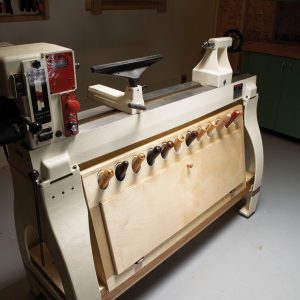
The extension table stores on the wall. This flexibility frees shop space that would have been occupied by my saw if it had a superwide- capacity rip fence.
I recessed the T-track and adhesive-backed rules in grooves in the extension. To calibrate the rules, I set the extension’s fence parallel to the blade and made a test cut. The width of this test piece now indicated the fence’s distance from the blade, so I used this measurement to install the rules. An L-shaped cleat mounted on the extension’s bottom allows storing the extension wing vertically.