We may receive a commission when you use our affiliate links. However, this does not impact our recommendations.


I have always waited for and dreaded the day when someone made a commercial workbench that I would consider buying.
That day might (almost) be here.
This week I am in Warren, Maine, to shoot a video for Lie-Nielsen Toolworks on building the Shaker side table from the second issue of Woodworking Magazine. I’ve shot a number of DVDs with the company but this one is different because I’m working on the company’s new workbench, which will be on display at Woodworking in America this fall.
In all seriousness: If you are in the market for a workbench, this should be at the top of your list and at the bottom of your list (in other words, it should be the only one on your list).
Yup, this is the only commercial workbench I’ve ever considered owning. Why? Let’s go through the features.
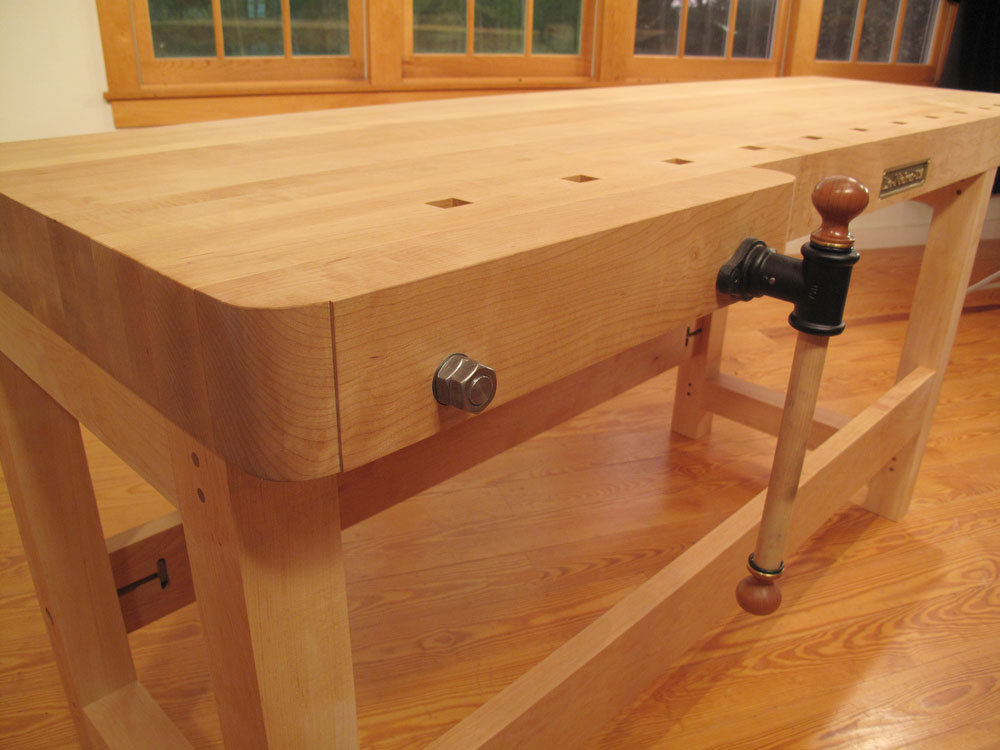
1. The top is 4″-thick solid maple and 7′ long. No skirt. No tool tray. Just lots of maple that you can clamp stuff to.
2. The front edge of the benchtop is flush to the front of the 3″-square legs. If you have read anything I’ve written during the last seven years, then you know that this is an important feature when it comes to working the edges of boards.
3. The tail vise cannot sag. I dislike the traditional tail vise. This bench does not feature the traditional tail vise. It cannot sag. It is awesome, and it doesn’t have the “L” shape, which is a bad thing in my estimation. Too many woodworkers use the “L” block to clamp stuff to the end. And… surprise! The L-block breaks off.
4. The face vise is a chain-drive twin-screw vise with 12″ between the screws. This is plenty enough for most operations. For wider case sides, the Moxon double-screw is the answer. More on this in a later post.
5. The lower 5-1/4″-wide stretcher is flush to the front edge of the legs and benchtop. That’s perfect – exactly how I would build it for myself.
6. The entire bench is made of beautiful and solid maple. Price: $2,000.
That might sound like a lot of money until you start pricing out the maple, the vise hardware, the dogs and your labor. I have done the calculations. And while I think that most woodworkers should build their own workbenches, this design is the best alternative ever.
Truth is, I’ll spend more than $2,000 on a laptop every couple of years. This bench will outlast you and your children. It is a steal.
Today I spent the entire day building stuff on this bench and I found nothing to complain about. It is solid, holds work firmly and has tight joints. I cannot ask any more of a workbench.
So if you are coming to Woodworking in America, I highly recommend you stop by the Lie-Nielsen Toolworks booth and give this bench a try. Sign up to get one made for yourself – I am sure that there will be a waiting list soon enough.
— Christopher Schwarz
• But if you are too cheap to buy a workbench, then I recommend my book “Workbenches: From Design & Theory to Construction & Use.” This book explains what makes a good workbench, whether you buy it or build it.