We may receive a commission when you use our affiliate links. However, this does not impact our recommendations.

I’ve looked at a lot of old workbenches, and I’ve never seen many that exhibit signs of being flattened. I always look at toolmarks on the benches and what I typically find are toolmarks that are recent and some that are quite old , based on the patina of the gouged wood and the amount of grime that has accumulated.
So benchtop flatness is a red herring, right? Maybe. If you work a lot on a bench that isn’t flat, you’ll see it affect your work. A low spot in the top will prevent you from planing the middle of a board. You’ll only be able to plane the ends of the board.
One possible solution is that woodworkers who toiled on less-than-ideal benches would use a planing board. Planing boards are thick assemblies that you lay over your benchtop and are set up to restrain the work. I first stumbled on them in the book “Modern Practical Joinery” by George Ellis. Despite its “modern” title, it’s an old book.
I made a planing board using Ellis’s description and text, and it works quite well. It’s an unusual piece of work: It’s a frame assembly and inside the frame are seven slats that float in grooves and can be slid a bit back and forth. Here’s where it gets a bit odd: The frame’s rails and stiles are 1-3/8″ thick; the slats are 1-1/2″ thick. The slats are proud on the bottom of the planing board. The top of the planing board is cleaned up flat and flush all around.
The differing thicknesses, I believe, might keep the whole thing flatter in the end. The center of the planing board will always be planted on the benchtop. You can easily true the underside because it is proud and then flip the thing over and true the whole thing. That’s a working theory. I have a few others as well.
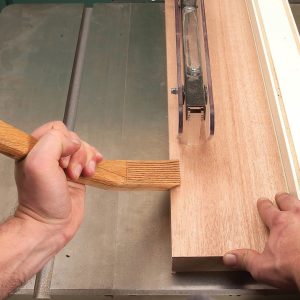
There are two planing stops at the end that adjust up and down. You can also restrain work for cross-grain planing by inserting wedges between the slat and pushing the work up against the wedges. This works great.
 And how do you keep the planing board on your bench? The book is quiet on this. I have mine pinched between dogs and against a dog at the back of the bench. I’m going to change this arrangement this weekend. I plan to put a hook on the front edge (just like on a bench hook for sawing). And then I’ll push the thing against a planing stop in use. There’s no need to have a tail vise.
On construction: I’ve included a pdf file below you can download if you like. Here’s the cutting list:
2 Stiles: 1-3/8″ x 4″ x 36-1/8″
2 Rails: 1-3/8″ x 4″ x 18-1/2″ (1-1/4″-long tenon on both ends)
7 Slats: 1-1/2″ x 3-7/8″ x 16-3/4″ (3/8″ x 3/8″ stub tenon on both ends)
After dressing your stock, plow a 3/8″ x 3/8″ groove down one long edge of each stile. Cut 3/8″-thick x 1-1/4″-long haunched tenons on the ends of the rails. Cut matching mortises in the stiles. Cut the 3/8″ x 3/8″ stub tenons on the ends of the slats.
Bore the two 3/8″ x 2″ through-tenons in one rail for the planing stops.
Dry-assemble the frame, clamp it up and make sure the slats will move when the assembly is put together. If everything works, glue up the frame and clamp it. When the glue is dry, dress the underside of the planing tray flat. Then flip it over and dress the entire top surface flat. Fit your planing stops and get a few wedges you can insert between the slats.