We may receive a commission when you use our affiliate links. However, this does not impact our recommendations.

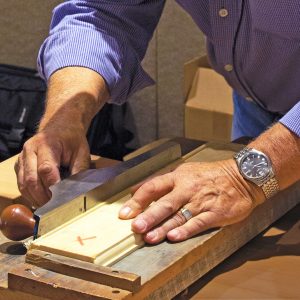
Here I am, dragging back my jointer plane on the return stroke.
I’m the first to admit that I have some bad habits. I drink beer. I occasionally curse. And I sometimes drag my planes back across my work on the return stroke.
When you receive traditional training, dragging a plane back across your work will get your knuckles rapped by the shop nun. That’s because when you drag the tool back with the sole flat on the work, the wood abrades the tip of the iron, shortening its lifespan.
This is true.
(A quick aside: Allow me to dispel a myth I hear a lot. Here’s the myth: “Dragging the plane back will actually sharpen the iron. Wood is abrasive – like a sharpening stone. So dragging it back actually sharpens the iron.” This is crazy talk. If the wood really did abrade the edge significantly it would be at an angle that would prevent the tool from cutting. It would, in geek speak, create a bevel that would violate the tool’s clearance angle. Anyway, please don’t buy into this load of metric nutjobbery.)
OK, where were we? Ah: This is true.

Some woodworkers simply lift the heel of the tool on the return stroke – exaggerated for emphasis.
So why do I drag my planes backward on occasion, becoming a bad example for small children and helpless animals who might be watching? I thought about my bad habit a lot during a seven-hour drive home on Sunday. And here is an explanation of when I drag a plane and why I drag only certain planes.
1. Jack planes: When hogging off material, the last thing I want to do is make the process more tiring. Lifting the plane, even just the heel, tends to slow me down and wear me out a little quicker. The jack doesn’t have to be real keen to do its job, so I don’t worry much about the edge.
2. Jointer planes: I use a No. 8. It’s dang heavy. I’ll lift it on the return stroke when I’m jointing an edge, but when I’m planing a case side or the face of a board, I admit I drag the sucker back. Perhaps I’m lazy or I’ve just developed this bad habit, but I prefer to drag. Why? I don’t have to get the toe of the tool settled as I make the transition from pulling back to pushing forward. The tool is already settled and in full contact with the work. In my mind I can save some time planing, but I might have to sharpen more often as a result.
3. Complex moulders: I drag complex moulders back on the return stroke to ensure they stay in the track I just made with my forward pass. It’s too easy for the moulder to hop out of the profile – so soon you are cutting the ovolo into the fillet, or worse. I don’t like to sharpen these tools, but I also don’t like throwing out sticks of botched moulding into the burn pile. So I drag.
4. Plows and rabbets: I think a fair number of woodworkers drag the planes back when they are using plow planes and rabbet planes. It’s a speed issue. If you lift the tool on the return stroke you will have to find the correct starting point before pushing forward again. Perhaps you can subtly lift the heel back as you pull back and stay engaged in the cut. You might also be a Jedi Knight of Joinery.

Other woodworkers tilt the plane slightly – again, exaggerated for emphasis – on the return stroke.
OK, here are the tools I almost never (consciously) drag back.
1. Smoothing planes: I hate sharpening and setting up these tools, so I tend to do anything I can to preserve their edges – including lifting the tool or its heel on the return. I am sure there are times (on video) I haven’t lifted the tool. But I prefer not to.
2. Block planes: Ditto all my reasons mentioned with smoothing planes.
3. Hollows and rounds: I sometimes drag these, but usually I don’t. Why? With every pass with these tools, you are usually adjusting their angle in a small or significant way. Plus, they are no fun to sharpen. So I try to lift them on the return stroke.
So there you have it: A short confession and explanation. If you take only one thing away from this blog entry, I hope it is the following sentence: Try not to drag your planes back on the return stroke. It really is the right way to work. But if you are a dragger, just remember that you are not alone.
And stay tuned: Tonight I’ll post what some of the authors of the previous two centuries have to say about this issue. It’s a bit murky.
— Christopher Schwarz
Honestly, I do know something about handplanes. I have a new and well-received DVD called “Super-tune a Handplane,” which shows you how to turn an old plane into a high-performance tool. You can check out that DVD at ShopWoodworking.com here.