
We may receive a commission when you use our affiliate links. However, this does not impact our recommendations.
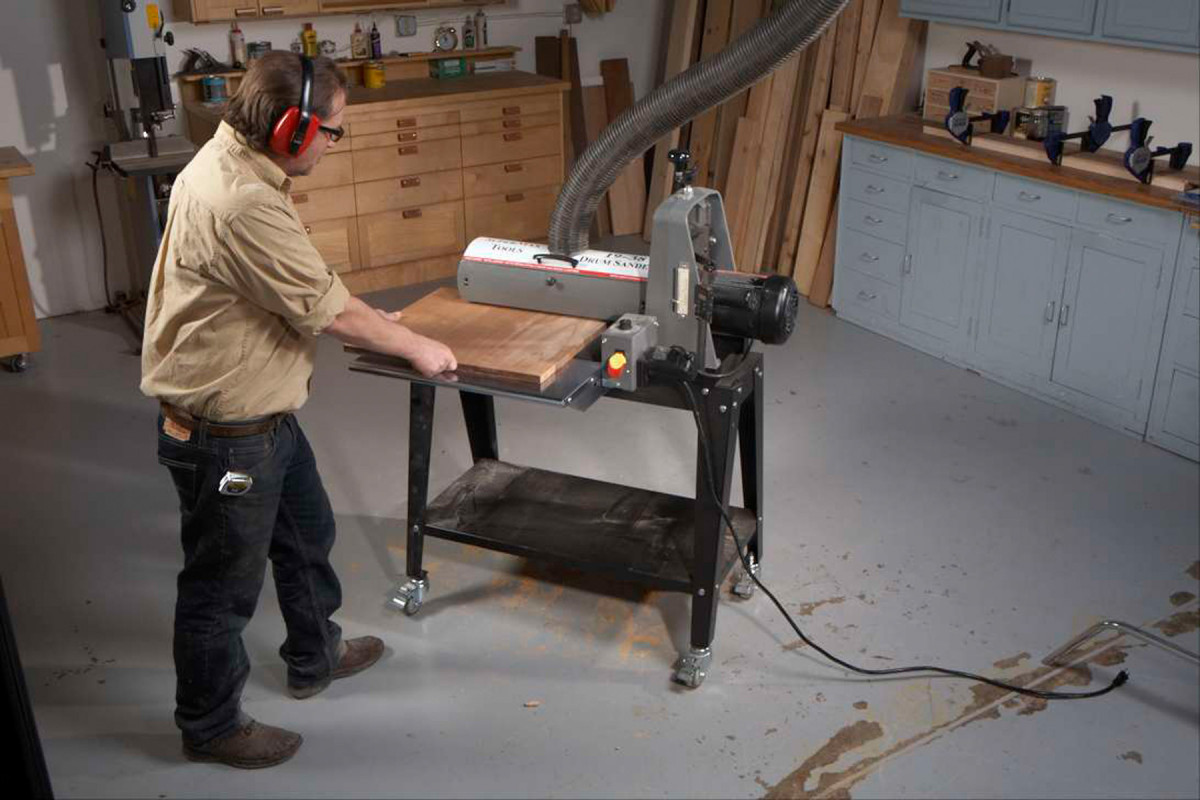
Tool: 19-38 Drum Sander Shop Now
Manufacturer: Laguna
MSRP: $2099
Drum sanders for small shops have been available for quite a few years now. If you’re looking for an upgrade to a basic open-end drum sander, look at the SuperMax 19-38. I’ve been using one for a few months now, and I can report that it’s one heck of a nice machine.
If you’re not familiar with what drum sanders are used for, I’d like to point out that a drum sander isn’t really a substitute for a planer—it’s a partner. A planer can remove a lot of material, fast; a drum sander works much slower. But there are three important ways that a drum sander can supplement your planer:
• A drum sander will never tear out the grain—even on highly figured wood—and can leave an incredibly smooth surface. The 19-38 uses sandpaper strips that range from 24 grit (for surfacing roughsawn boards) through 80 grit (for removing planer ripples) and on up to 220 grit (for finish sanding cabinet doors, for example).
• An open-end drum sander can handle very wide material. You just run your stock through twice, flipping the piece around between passes so each side goes under the sanding drum. The 19-38 can handle pieces up to 38″ wide this way, or up to 19″ wide in a single pass.
• A drum sander can also process very short material. The 19-38 can sand pieces as short as 2-1/4″ long.
The first thing I noticed about the 19-38 was the enormous amount of cast iron used in its construction. (It weighs 286 lbs., without a base!) This large mass dampens vibration and stiffens the sanding arm, enabling the machine to perform very precise work. You’ll get less than .010″ variation in thickness across the sander’s width, according to SuperMax.
The second thing I noticed was the 19-38’s huge motor. Rated at 1-3/4 hp, this motor pulls just about as much power as you can get from 120 volt household service. You’ll need that extra power when using coarse 25 grit paper on wide stock. It’s best to dedicate one 20 amp circuit in your shop just for this sander.
The last big thing I noticed was that the 19-38’s head doesn’t tilt. On older open-end sanders, you’re supposed to slightly tilt the head when sanding wide stock to avoid overlap marks. The downside is that you have to fiddle with bolts to tilt the head, then re-calibrate the machine to level the head when you are done. The 19-38 is much easier to adjust: The bed tilts, not the head, and it’s indexed. To tilt the bed .003″, all you do is flip a lever. To get back to level, you flip it again. Simple!
The conveyor belt on the 19-38 is powered by a separate, direct-drive DC motor, giving you an infinitely adjustable feed rate from 0-10 feet per minute. For surfacing roughsawn boards, you select a fast feed rate; for finish sanding, you use a slow to moderate feed rate.
Available options include a set of casters, a closed stand with casters, a digital readout and infeed/outfeed tables.
Here are some supplies and tools we find essential in our everyday work around the shop. We may receive a commission from sales referred by our links; however, we have carefully selected these products for their usefulness and quality.