We may receive a commission when you use our affiliate links. However, this does not impact our recommendations.
 At the HandWorks show in Amana, Iowa, last month, Veritas introduced publicly its newest innovation in workholding – a cam-lever hold-down that to me, looks like a duck. So until I’m told the official name of the tool, I’m calling it a Bench Duck. (I’ll likely call it that even after I know the official name.)
The Bench Duck is bit of a combination of the excellent (but spendy) Veritas Hold-Down (a venerable surface clamp that has worked predictably and well in every bench on which we’ve tried it) and a traditional holdfast. It has what appears to be the same 3/4″ diameter, 10″ long barbed post (and an optional 5-1/2″-long shaft for holes that allow limited travel) as the company’s hold-down, but instead of a brass clamping knob and pivoting arm, the Bench Duck has a cam lever that flips down to exert force on the arm and bend it slightly at the neck to secure firmly in place what it’s holding.
Does it clamp as tightly as the Veritas Hold-Down? No, because you can crank the knob of the aforementioned to exert enormous force – as much as your hands are capable of turning it – but the pre-production Bench Duck clamps securely enough everything to which I’ve subjected it over the last couple weeks. I’ve used it to hold both my Benchcrafted and Tools for Working Wood (TFWW) Moxon vises while marking and sawing out dovetail waste (the Benchcrafted vise on my 5″-thick white pine bench at home; the TFWW vise on my 2-1/2″-thick laminated-veneer-lumber (LVL) bench (a.k.a. The Gluebo) at the Popular Woodworking Magazine shop). I’ve also tested the Bench Duck while securing work flat to my LVL bench while chopping out a mortise, and while removing dovetail waste (though I typically use my elbow for that application).
One of the reasons I like the Veritas Hold-Down so much is that I don’t need a mallet to use it. That’s not a big deal when one’s bench is away from the wall (or easily moved), or a holdfast is in a hole along the front edge. There, it’s no problem to bang it on the backside to release the pressure. But at home, my bench is against the nicely painted wall of my study/shop, so there’s but 2″ between the wall and the dog holes. I can’t get a mallet back there without imminent risk of a plaster repair. (Yes, I can move the bench away from the wall, but that requires dragging it across the nice hardwood floor and scratching the finish; I’m working on a solution for that ongoing and vexing situation). Both the hold-down and this new cam-lever version obviate the problem; a turn of the handle or a flip of the lever, and the pressure is released. No smacking – of either the wall or the tool – is needed. (And sometimes, well, I just can’t find my mallet.) And the Bench Duck will cost less than the $79 Veritas Hold-Down – so same functionality for less outlay.
The new tool is not yet up on the Lee Valley/Veritas web site, nor do I have information as to the materials or pricing. I’ll report back just as soon as I know more – which I’m told will be very soon. What I do now know is that I’ll be ordering a couple of Bench Ducks* for my shop at home.
* Again, this is not the official name of the tool. While Robin Lee would never be so rude as to roll his eyes at anyone – ever – I suspect they may have been mentally rolling just a wee bit when I quacked at him about it in Amana.
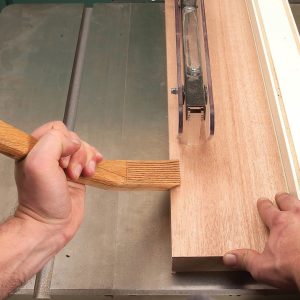
p.s. The mallet pictured in the photo at top is a medium-sized Springwood Industries maple joiner’s mallet, approximately 14.7 ounces, available from The Best Things. At first use, the handle and weight are comfortable, and the tool is well-balanced. We’ll be testing it out fully soon and reporting back. The pictured chisel is a 3/8″ Veritas PM-V11 from Lee Valley.
p.p.s. If you’re looking for more information on securing your work, read Christopher Schwarz’s “A Workholding Renaissance” from our April 2013 issue or “The Workbench Design Book” which has a chapter on the subject as well as plans for nine workbenches, including my LVL bench and his 18th-century Roubo that was built by hand. (Mine at home is the same design…but I was glad to use a jointer, planer and band saw for the heavy work, thank you very much.)