We may receive a commission when you use our affiliate links. However, this does not impact our recommendations.
 The difference between school and real life is that in real life the tests come first and then the lessons. This is especially true of woodworking; you never know how far you should take one step of a project until you are knee-deep in the next step. That’s when you realize you didn’t fuss enough and now have a painful correction to make, or that you fussed too much and spent a lot more time than you needed to on something that doesn’t matter. With enough experience you land in the middle and create nice work in a minimal amount of time.
If most of your woodworking experience consists of reading there are several traps waiting for you. The first is believing that reading about woodworking is the same as woodworking. Without practical experience, you’ll never really know which techniques work for you and which are a waste of your time, your money or both. You can’t judge the importance of any tool or technique by the volume of words used to describe or debate it, or by how many times something is repeated.
 Hand tools in general and planes in particular are excellent examples. You might have picked up the notion that planes exist for the purpose of creating fluffy shavings and that each part of your project must be individually planed to perfection with the thinnest possible shavings. Only then can you employ your other specialized tools to make perfect joints and when you put things together all will be well. Things that sound good in print don’t always make sense in the shop.
I’ve never been patient enough to make a perfect part or a perfect joint, but the furniture I make turns out pretty nice when I’m done. In my world, the most valuable function of a hand plane is to bring two surfaces that are pretty close to each other into alignment. Instead of fussing over the last few thousandths of an inch when milling parts or making joints, I shave them off either during a dry run assembly or after final assembly.
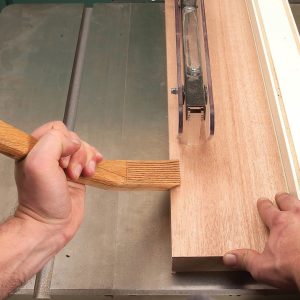
 A hand plane is the ideal weapon for this. Park the toe of the plane on the high side, the heel of the plane on the low side and push. This is faster, easier and gives better results than any other method I know. You need to know how to get your plane pretty sharp, and if you use a bevel down plane with a cap iron, it pays to set the cap iron close to the edge. It’s OK to skew the plane at an angle across the joint or go against the grain if you need to. There is a minor risk of doing some damage, but no where near the injuries you can inflict with a belt sander or random orbit sander. Sending the panel through a wide-belt sander is easier, but that leaves cross-grain scratches that need to be sanded out.
When you leave the romantic nonsense and magical thinking behind you’ll discover that a plane is fast and efficient for some tasks and slow and tedious for others. Tools have evolved to make them easy to use and a simple way to decide on a particular method is to weigh the time it takes vs. the quality of the finished product. If it isn’t easy and fun, there is probably a different approach that will be. As with anything you read, try it for yourself and practice it a few times before you adopt it or recommend it.