We may receive a commission when you use our affiliate links. However, this does not impact our recommendations.

When I learned to sharpen planes, the mantra was: Bench planes need a curved cutting edge, joinery and block planes need a straight cutting edge. And in a lapse of journalistic crotchetiness, I never questioned that rationale through four presidential administrations.
A couple months ago David Charlesworth, a British craftsman, author and teacher, called to help me with another story and mentioned offhandedly how he would sharpen block planes with a curved iron. I briefly raised an eyebrow and then we plunged into some other topic.
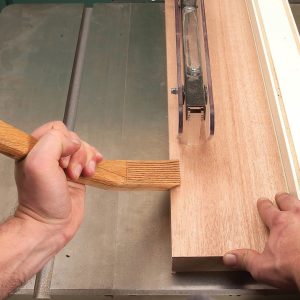
Somehow his comment got stuck in my head and so for the last several weeks I’ve been experimenting with using a curved iron in one of my block planes. And what I’ve found is that a gentle curve in a block plane iron is a nice thing in some instances. When flushing up joints, a curved iron leaves a slightly scalloped surface like that of a smoothing plane, so there’s less (or no) follow-up scraping or sanding to do. No plane tracks.
Another advantage when flushing up joints is that you can use the curve to sneak up on an intersection of a rail and stile. In essence, you are using the fact that the tool is taking a very light cut at the edges of the shaving, which is a powerful tool. Here’s how. Let’s say that you are trimming the proud stile to be flush with the rail. By paying attention to the width of the shaving you can position the plane the thinnest part of the shaving will cross the joint line between rail and stile.
This approach put the heaviest part of the cut on the stile and just barely touches the rail, which is cross-grain to the stile. So there is much less clean up (if any) to do once the joint is flush. I found the same advantage when trimming proud end grain (such as with a rabbet) so it’s flush with the surrounding face grain.
There are times when the curved edge isn’t so ideal. I do a lot of shooting of small muntins for divided-light doors (a current project). And I really like a straight cut for the shooting process. It keeps the edges true through their thickness.
I have a few block planes, so having two shapes of irons isn’t a big deal. I sharpened one of my little block planes with a coffin-shaped body with a curve. Coffin-shaped planes are no good for shooting anyway so I won’t ever mistakenly grab a curved-iron plane for a straight-iron job.
So how much curve is correct? I sharpened it like a smoothing plane. First I clipped the corners with a file, rounding them over. Then I sharpened the iron in a honing guide using finger-point pressure. Six firm strokes at the corners. Three medium strokes at a point between the middle of the iron and the corners. Then I checked my work to make sure the curve looked good.
Next sacred cow, please.
– Christopher Schwarz