We may receive a commission when you use our affiliate links. However, this does not impact our recommendations.

In my kindergarten class, someone was snitching cookies from the lunchboxes of the rest of the class. (Spoiler alert: It was the fat kid.) While the teacher’s investigation was ongoing, she gave us a speech that I still remember.
“I once had a student who stole cookies,” she said. “Then he stole lunch money. Then he stole money from his parent’s wallets…¦.”
Long pause. “Then he robbed a gas station.”
If you are still in the “smoothing plane” (stealing cookies) stage of your slide into handtools, let me give you a peek at some of bad deeds you’ll be committing against your family’s checkbook in the years ahead. First stop: plow planes.
Plow planes make grooves in the edges and faces of stock, which is great for frame-and-panel work. They also can be adjusted to make the tongue on a tongue-and-groove joint. And they are great for wasting away stock when you are making decorative moulding with moulding planes.
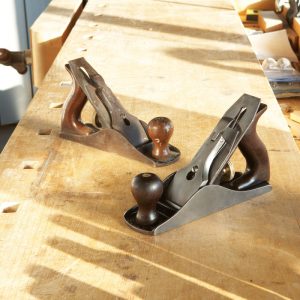
There are many different kids of plow planes, but I think there really are two families: the wooden plows and the metal plows. And their differences are in more than the raw materials used to make them.
Because that’s the most obvious difference, however, let’s start there.
Metal vs. Wooden Bodies
If you’re buying a used plow, the metal ones are usually in better shape than the wooden ones. And the metal ones can usually be resurrected a little more easily. That’s because the wooden body of a plow can warp (very difficult to fix), and the wooden wedge that secures the iron can be frozen in its mortise or can be so modified that it is useless.
That said, I always prefer a wooden grip on a plane, so the metal grips aren’t my favorite. Heck I’ve thought about wrapping some friction tape around the handles to improve the feedback.
Where the Shavings Go
In use, the biggest difference for me is where each tool’s shavings go. On the metal plows, the shavings eject into the fence and the user’s hand. This is annoying because many times the shavings bunch up like a wad of toilet paper in the fence and you have to stop your work and clear things out.
On the wooden plows, the shavings are ejected away from the user and onto the benchtop. I have yet to find a disadvantage to this way of work , except that you have to sweep off your bench once in a while.


About that Fence
The fence on a metal plow is usually secured with two thumbscrews. Because of the tight tolerances when the tool is made, it’s usually simple for the user to get the fence parallel to the tool’s skate , a critical detail.
With wooden plows, it’s all over the map. Fences can be fantastic or one step above semi-adjustable firewood. The bridle mechanism on my D.L. Barrett & Sons plow is perfection. It’s better than a metal plow. One thumbscrew locks everything, and it’s always parallel to the skate.
However, most of the wooden plows you’ll find have two wooden screws that adjust the fence (or sometimes wedges do the job). With the two wooden screws, it’s a bit more of a hassle to get things parallel. Plus, sometimes these screws are damaged beyond saving.


Different Depth Stops
On a metal plow, the depth stop is on the side of the skate that is opposite the fence. On the wooden plow, the depth stop is between the fence and skate. I haven’t found either to be troublesome, but you do have to pay attention to your work. You don’t want to waste away part of the wood that you are going to need your depth stop to contact on a later cut.


I work with both tools and find that they both do everything a woodworker needs. The choice of tool comes down to:
– How much you can spend
– What is available in your area
– How much work you want to put into the tool
– And which form makes you drive by Texaco stations that aren’t on your way home.
– Christopher Schwarz
Looking for More Woodworking Information?
– Sign up for our newsletters to get free plans, techniques and reviews HERE.
– Looking for free articles from Woodworking Magazine? Click HERE.
– Like hand tools? Read all our online articles on hand work HERE.
– Want to subscribe to Woodworking Magazine? It’s $19.96/year. Click HERE.