We may receive a commission when you use our affiliate links. However, this does not impact our recommendations.
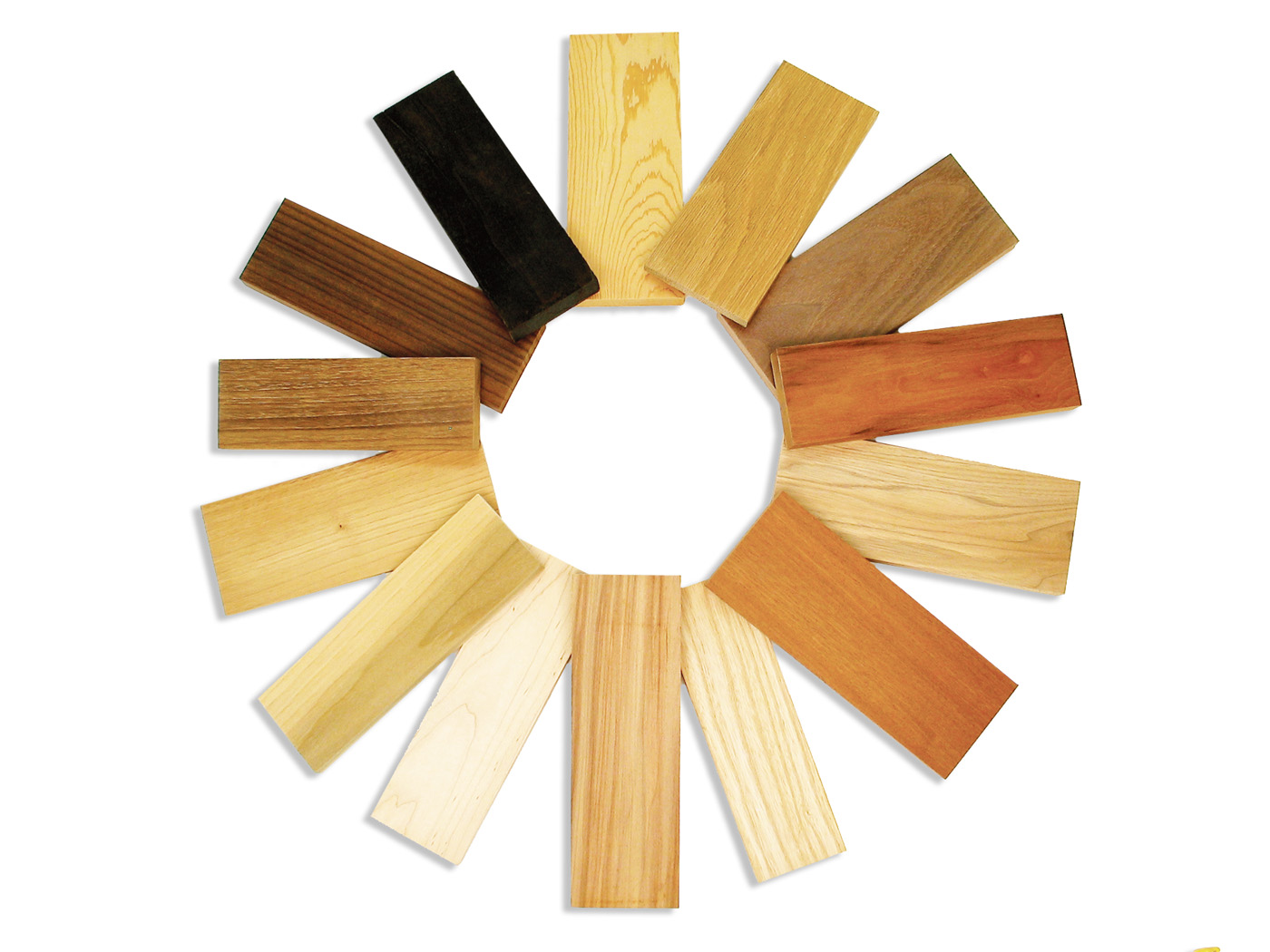
A fan of woods. Pictured are a number of woods woodworkers choose among for projects. Clockwise from the top are pine, oak, walnut, cherry, butternut, mahogany, ash, gum, soft maple, poplar, chestnut, teak, rosewood and ebony.
Organize all the woods into categories to determine the best finishing strategy.
Woodworkers choose among dozens of wood species for projects. Unless you’ve actually used many different woods and experienced how they machine, feel, smell and respond to stains and finishes, you probably find making an intelligent choice confusing. There needs to be some way to organize the woods so decisions are easier.
And there is.
To begin with, you can divide all woods into five large categories: pine and related softwoods; coarse-grained hardwoods; medium-grained hardwoods; fine-grained hardwoods; and exotics.
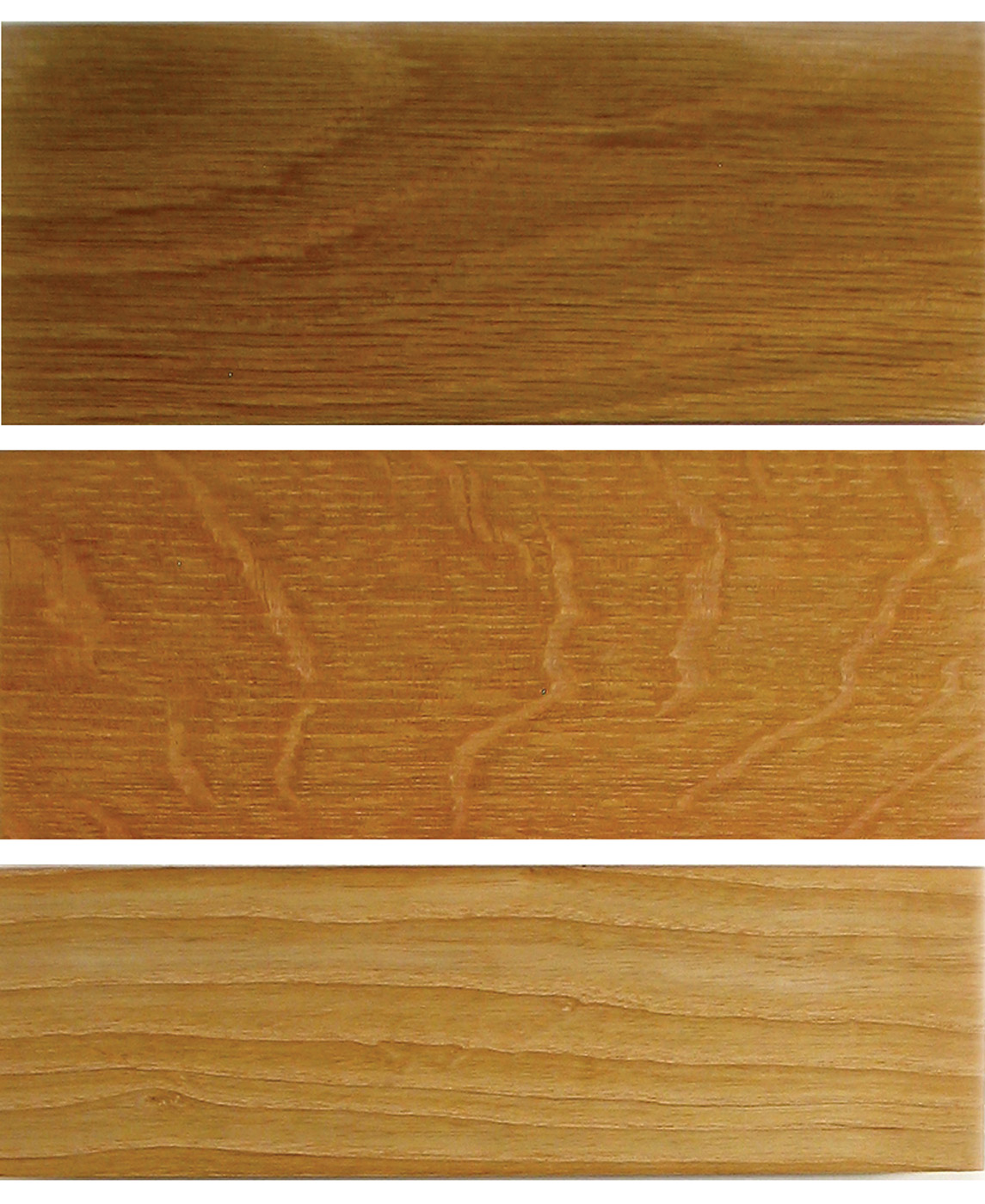
Coarse-grained woods. Common coarse-grained woods include from the top: plainsawn oak, quartersawn oak and ash. All stains and finishes look good on these woods.
Traditional furniture is rarely made of pine or exotics, so for simplicity’s sake, let’s reduce the categories to three: coarse-, medium- and fine-grained hardwoods. And to begin with, let’s deal with just the five most common traditional furniture hardwoods: oak, walnut, mahogany, cherry and maple.
Importance of Grain
Grain is the most important indicator for identifying woods. Grain is the open pores or pitting in wood that give it texture. In finished wood you may have to look closely to see the grain because it may have been filled.
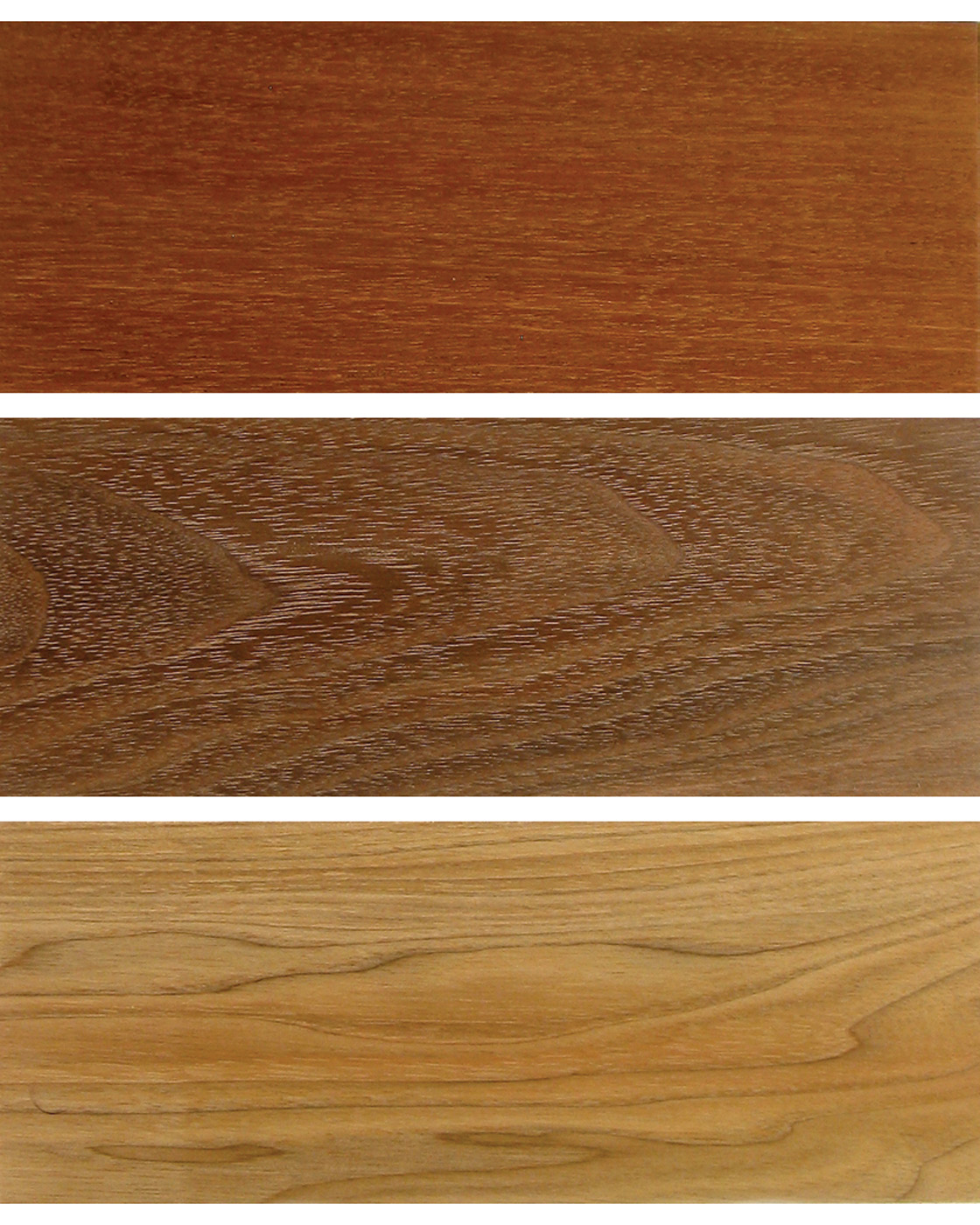
Medium-grained woods. Three common examples of medium-grained woods used in woodworking are from the top: mahogany, walnut and butternut. These woods are widely considered the most elegant when their pores are filled. All stains and finishes can be used successfully.
Most old furniture was made with one of these five woods, so identifying woods in antiques is fairly easy. If the grain is coarse, the wood is likely oak. If it is fine – that is, if there’s no obvious pitting – the wood is probably cherry or maple. If there is pitting and it’s finer and more evenly spaced than in oak, the wood is almost always walnut or mahogany.
To tell the difference between cherry and maple and between walnut and mahogany, the color of the heartwood is key. On an antique you may need to cut a sliver from an inconspicuous place to see its color. On newly milled wood, you can simply look at the color.
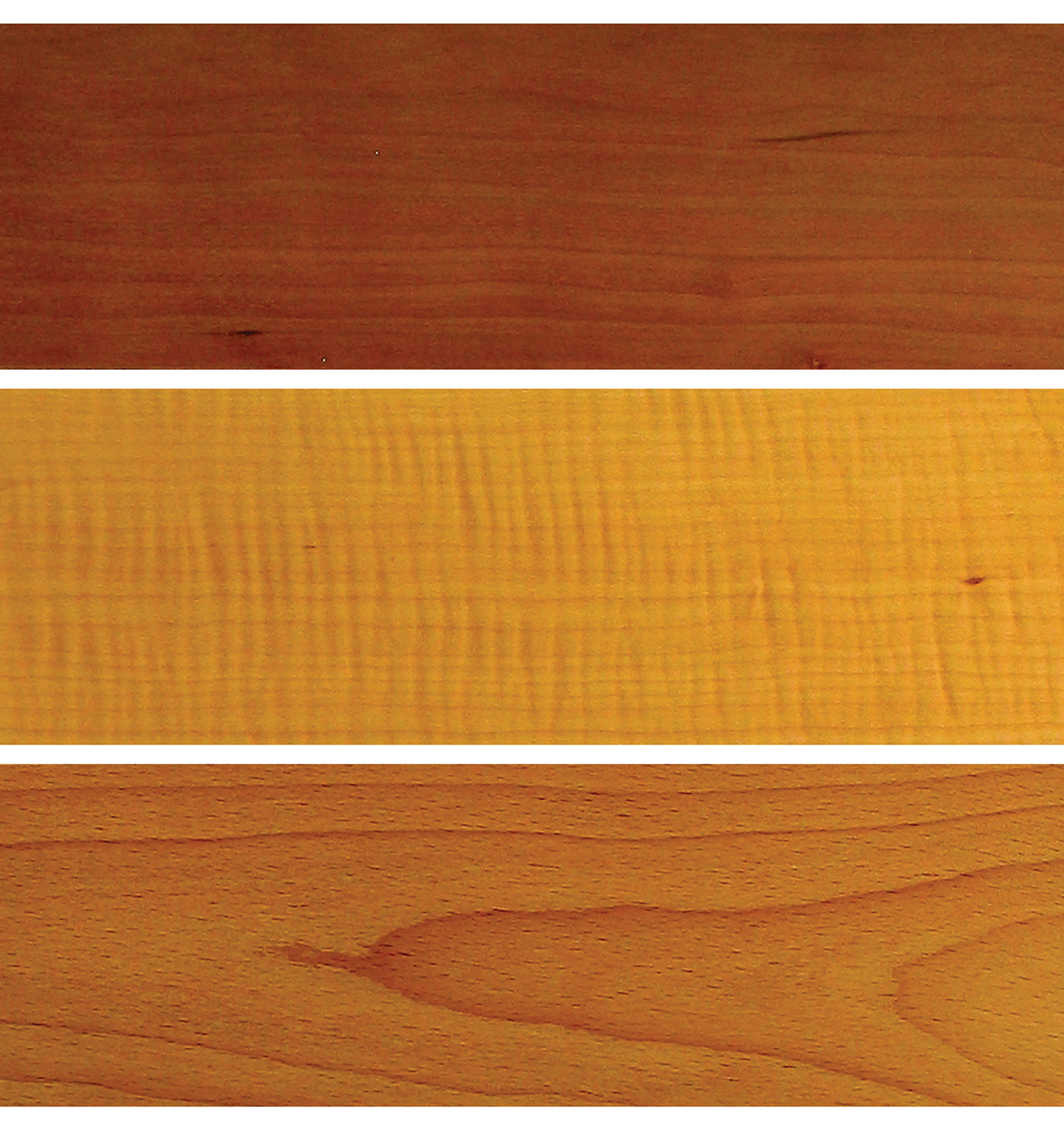
Fine-grained woods. Woodworkers use a great many fine-grained woods. Examples include from the top: cherry, curly maple and beech. As with most fine-grained woods, these tend to blotch, especially when stained. But the blotching is often considered attractive as with curly maple. Water-based finishes look especially good on the white woods but make darker woods such as cherry look washed out unless a stain is used.
If the color of fine-grained wood has a reddish tint, the wood is cherry. If near white, it’s maple. If the color of a medium-grained wood is charcoal gray, it’s walnut. If reddish, the wood is mahogany.
Keep in mind that oak can have a coarse grain when plainsawn, or less coarse when quartersawn. Quartersawn oak is usually easy to identify because of its medullary rays.
Additional Woods
Of course, wood identification becomes more difficult when more woods are added. Traditionally, chestnut, elm and ash were sometimes used instead of oak. Each is coarse grained but subtly different. You just have to learn to recognize these differences.
Butternut, hickory and pecan were also used, and their grain resembles walnut and mahogany. Color can help in identification. Butternut is tan; hickory and pecan are tan with a slight pink cast.
There are lots of fine-grained woods in addition to cherry and maple, including birch, poplar, gum, beech, yew and holly. Gum and beech have a color similar to hickory and pecan. Yew is light brown to reddish. The heartwood of poplar has a distinct greenish color, which ages to light brown. The others, and the sapwood of poplar, are near white.
To distinguish between these fine-grained woods, you need to recognize subtle differences in figure. Figure is primarily grain orientation, the appearance of which has a lot to do with the way boards and veneer are cut, but also small distinguishing characteristics such as the flecks in cherry, maple and beech.
Exotic Woods
Mahogany could be classified as an exotic wood because it grows in jungle areas. But mahogany has been used so extensively for so long, it makes more sense to classify it as a medium-grained wood along with walnut, hickory and pecan.
With the exception of teak and rosewood, exotic woods were rarely used until recently, and then usually just for decoration and veneer. Now a wide variety of exotic woods are used for bowl turning, decks and furniture.
Most of these woods are medium-grained, but many are very distinctive in color and figure and therefore fairly easy to identify once you have become familiar with them. I don’t have any easy categories that will help.
Finishing the Five Categories
Here are some thoughts about finishing each of the five categories of wood.
Pine and related softwoods have a very pronounced grain – soft, absorbent, white spring growth alternating with hard, dense, orange summer growth. The spring growth absorbs stain well, but the summer growth doesn’t. So staining these woods usually reverses the color, making the spring growth darker than the summer growth.
Pine also tends to blotch, which can be quite unattractive.
On the other hand, pine finishes well with any finish, though I don’t like oil finishes because so many coats are usually required to bring the sheen of the spring growth even with that of the summer growth.
Like pine, fine-grained woods tend to blotch – often in an unattractive way. But sometimes, as with curly, bird’s-eye and mottled woods, the blotching is attractive. As I have described often in these pages, you can reduce the blotching by applying a washcoat (thinned finish) before applying the stain, but the coloring will then be lighter.
All fine-grained woods finish well with any finish, but oil finishes require many coats for a nice appearance. Water-based finishes look wonderful on the white woods because they don’t add any yellow/orange coloring, but they make cherry look washed out unless a stain is applied under the finish.
Medium-grained woods finish to look the most elegant of all woods as long as the pores are filled. This is one reason mahogany and walnut have long been considered the premier furniture woods.
All finishes except water-based look wonderful on these woods, and water-based also looks fairly good if a stain is applied under the finish.
All stains and finishes also look good on coarse-grained woods. Only quartersawn oak looks good filled. Plainsawn, coarse-grained woods look plastic, in my opinion, when filled. The filled areas are too wide.
Water-soluble dye stains don’t color the pores well in coarse-grained woods. If you use a water dye, follow it with an oil-based wiping stain of a similar color, either directly over the dye or over a washcoat, to add color to the pores.
All stains and finishes (water-based with a stain applied underneath) also look good on exotic woods. The common finishing problem with these woods is getting an oil or varnish finish (not others) to dry in a reasonable time because of the natural oily resins many of these woods contain.
To overcome the problem, wipe the surface with naphtha or acetone just before applying the first coat of oil or varnish. Then apply the finish right after the solvent evaporates off the surface.