We may receive a commission when you use our affiliate links. However, this does not impact our recommendations.

One of the biggest struggles with learning hand tools is finding instructions that make sense. Many modern hand tool teachers have taught themselves to saw, plane and chop. And while their idiosyncratic techniques might work, they also can be inefficient.
You can go back to the original published sources, such as Joseph Moxon’s “Mechanick Exercises,” but the instructions there assume you are a denizen of the 17th century. So when you try to learn about using the hatchet, these are the instructions:
“The hatchet marked L, in plate 4. Its use is so well known (even to the most un-intelligent) that I need not use many words on it, yet this much I will say: Its use is to hew the irregularities off such pieces of stuff which may be sooner hewn than sawn.”
Then there’s Roy Underhill, host of PBS’s “The Woodwright’s Shop” and author of six books on the craft. He is one of the few people I’ve ever met who can bridge the gap between the hand craft of the pre-industrialized world and today. He reads Andre Roubo’s works in the original French. But he carries a Macintosh laptop, codes his own animations and is on television.
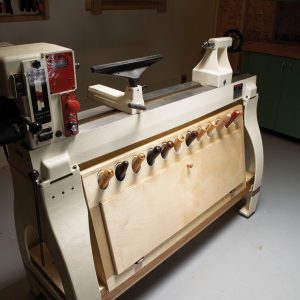
This summer while I was teaching at the Northwest Woodworking Studio in Portland, Ore., Underhill and I overlapped by a couple days , he was teaching a class in making a lathe the weekend before my class on handsawing began. While we were chatting, he handed me a loose-bound copy of his latest book “The Woodwright’s Guide: Working Wood with Wedge & Edge” (UNC Press).
During the following week, I devoured the entire tome during my free evenings with the company of a few great Portland beers.
I own all of Underhill’s books. They are dog-eared second-hand affairs I picked up after finishing college that I have carried with me from town to town. I laugh out loud every time I read “The Debate of the Carpenter’s Tools” in “The Woodwright’s Work Book.” (Yes, I am aware this is a problem and there is help available.)
So it is no small thing when I say that Underhill’s new book (his first in 12 years) is his best. For starters, this book uses illustrations (by his daughter Eleanor Underhill) instead of photographs. This lends an air of consistency to the work and also allows you to focus on what is important in each image (instead of wandering over to look at the chisels on his bench in a photo).
The narrative of the book is just as clear. It begins in the forest with a description of a tree being cut down by a faller. Then you follow the tree as it passes into the village in the hands of the cleaver and countryman, the hewer, the log builder, the sawyer, the frame carpenter, the joiner, turner and cabinetmaker.
Each profession brings new skills into the narrative, but they are all joined by the fact that they manipulate the wood by splitting it or shearing it (by wedge or by edge). You clearly see how edge angles (simple geometry!) flow throughout and unite all the professions.
And, as you might expect, the prose itself is enlightening, literate and amusing. As Underhill writes about the qualities of wood:
“Like age on a man, water makes wood softer, heavier and fatter , but not taller.”
Unlike his previous books, however, “The Woodwright’s Guide” is focused entirely on technique. Good thing, because that is what is sorely missing from the space between our ears. We can all find plans for a tool tote, bench or cabinet to build. But figuring out how to make a rule joint with moulding planes is beyond the grasp of most.
Underhill’s other great strength is his ability to explain extremely complex ideas in a way that makes it feel like you’ve suddenly achieved Buddhist enlightenment. In this book, Underhill’s explanation of how to determine and mark out compound angles for the splay of a sawhorse was worth the price of admission. I went around for several days after that in a giddy haze at finally , finally , understanding it. (The beer also assisted this warm and fuzzy feeling.)
And whatever you do, don’t miss the book’s short but hilarious and thoughtful conclusion titled “A Great Wheel.” I refuse to spoil it in any way by even giving you a hint.
The book is not available yet, but you can pre-order it from a variety of sources, including direct from the publisher.