We may receive a commission when you use our affiliate links. However, this does not impact our recommendations.
“Tricks of the Trade” is one of the most well-liked sections in our magazine. Here are four of these reader-submitted woodworking tips from the many we published last year. Enjoy! And if you like what you see, consider a subscription to the magazine. The content is deep. You’ll learn a ton with each issue.
Tell us some more of your favorite tricks in the comments section at the bottom of this post!
–Dan Farnbach
Drill Bit as Set-up Block
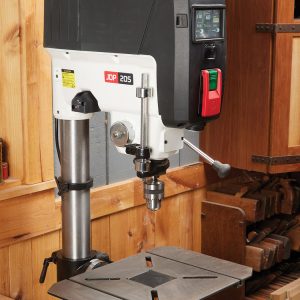
 Need a quick and precise way to set the fence on your router table, mortiser, drill press table saw or band saw but don’t have those fancy set-up blocks? Yes, you do – your drill bits.
Just choose the appropriate-size bit and use it as a spacer to set the fence. It also works for setting a precise distance on components of your projects.
Rob Cairns
Nevada City, California
Use Car Jacks in the Shop to Lift and Level
 I have long used my car’s scissor jack for house and shop projects. When I needed to install a new set of cabinets in my shop, I realized that a pair of these jacks would be perfect for positioning and leveling them.
I clamped both scissor jacks to a scrap piece of 3/4″ stock to provide stability. I also blocked them up so the scissor extension was sufficient to lift the cabinets into position.
Bill Wells
Olympia, Washington
Inlay Stringing the Easy Way
 Here is a trick I learned a few years ago from a fellow member of the St. Louis Woodworkers Guild. First, buy a hand-cranked pasta machine. Then run a sheet of veneer through it (not paper-backed veneer). Voila! Instant string inlay! Now just shape a scratch stock blade to match the width and you can add a string inlay border to your piece in very little time.
Pro Tip: Don’t use your wife’s pasta machine. And don’t spend a lot of money on a brand-new one. You can find them at garage sales.
Ethan Sincox
St. Peters, Missouri
Universal Planing Stop
 Last week, I restored a couple old Millers Falls planes for a co-worker. I wanted to give him a quick lesson on how to operate his tools, but in the middle of a bunch of cubicles, workholding is at a premium. So we came up with this quick planing stop, using only a pencil and some duct tape. Wrap the pencil in the tape, then stick it down wherever you need a planing stop. This worked so well, I am sure I will use it on my workbench at home for thin stock.
Trevor Angell
Andover, Kansas