We may receive a commission when you use our affiliate links. However, this does not impact our recommendations.

If workbenches were like automobiles, then I’d consider the tail vise to be like the heated seats in a car. They’re an option, of course, but they are by no means standard equipment, like tires.
Out of economic necessity, my first three workbenches didn’t have tail vises, and so I was thrilled when I was assigned to review a full-size European workbench with all the bells and whistles, including a tail vise and massive square steel dogs.
I wasn’t impressed. The vise sagged after regular use, the steel dogs constantly slipped back into their holes (no matter how I bent them) and the vise got in the way of many operations on the right side of the workbench.
Since that first bench, I’ve had the opportunity to work on workbenches all over the world with the best tail vises – wooden, steel, tubular, you name it. I haven’t been swayed in my opinion of them. When students use them, they apply too much pressure, bowing the work off the benchtop. Or the vise sags, and the dogs have to be struck with a mallet to get the work resting on the benchtop. And dogs won’t stay above the benchtop, which requires three hands to clamp a board. Oh, and when they have to plane boards of many different lengths, they have to move the dogs all around and screw the vise in and out a lot. It’s slow.
So I do I secure boards on the bench to plane them? I don’t. About 90 percent of my handplaning is done against a planing stop on the left end of my bench. Narrow stock goes right against the planing stop. Gravity and the force of the plane keeps it in position. For wide boards, I put a batten across the workbench top – it rests against the stop and is held by a holdfast.

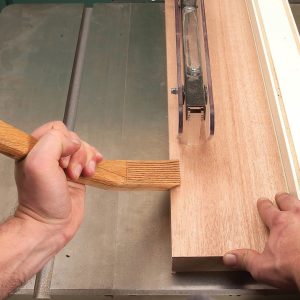
When I need to traverse boards, I use a doe’s foot and a planing stop. For sticking mouldings, I place a 2×4 against the planing stop and secure it with a batten, creating a simple sticking board. When using “fenced” planes, such as a plow plane, I have a number of strategies depending on the width of the work that involve a holdfast and occasionally a handscrew clamp.
Why Am I Telling You This?
I know that people who love tail vises will howl at this blog entry. And if you have a tail vise and adore it like your firstborn, then Godspeed to you. But if you are a beginner who is contemplating building that first workbench, I’d like to make the case that maybe your first workbench can be simpler, less expensive and easier to build.
Woodworkers built furniture for centuries without a tail vise. The first evidence we have of the invention of a tail vise is a drawing in a codex from 1505 in what is now Germany. The tail vise was embraced in Germany and in many Scandinavian countries. But some cultures – French, English, Chinese and Japanese – resisted the tail vise until the 19th century when it became ubiquitous on many Western-style workbenches.
If you’re interested in exploring the pros and cons of workbench vises then you probably would be interested in my book “Workbenches: From Design & Theory to Construction & Use, Revised Edition.” In that book, which might be available at your library if you don’t want to own it, I discusses all manner of vises and show how to get the most out of them.
— Christopher Schwarz