We may receive a commission when you use our affiliate links. However, this does not impact our recommendations.

Between bites of salad, Kevin Drake pauses to take a close look at the common chair sitting in our local Panera.
When I look at the chair, all I see is your typical bent-lamination, factory-made, comfortable-for-about-32-minutes padded chair.
But Kevin, the founder of Glen-Drake Toolworks, sees a lesson in Japanese aesthetics and composition by Japanese arts teacher Shozo Sato. What is the dominant focus for the viewer? What is the sub-dominant; the subordinate?
I was chewing my food at the beginning of the explanation, but by the end I was listening so intently that I forgot about the baguette soaking in my own mouth juices as I finally “saw” the chair.
Nothing makes me happier than to have lunch with someone whose brain is on fire with ideas different than mine. Someone who sees the same world with different eyes.
Which brings us to handsaws.
It’s a common thing to read in woodworking texts that the ripping teeth in a Western saw (power- or hand-driven) are shaped like chisels. And that crosscutting teeth are shaped like knives.
But when Kevin sees sawteeth, he sees something different. He sees the function of the teeth relating more to its “rake,” which is how forward or backwards each sawtooth leans. On a handsaw, teeth with the cutting face straight up have “zero rake.” Teeth that lean forward into the cut have a more aggressive rake. And teeth that lean backward have a relaxed rake. (Whether the rake is “postive” or “negative” depends on whether it’s a power tool or hand tool user describing it.)
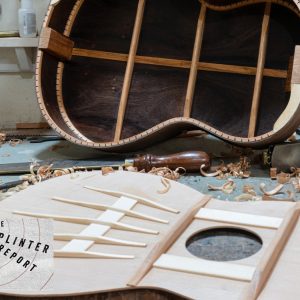
To Kevin, Western ripping teeth don’t look like chisels; they look like scrapers. Scrapers attack the work in an almost vertical position , like a zero-rake sawtooth. I can see this (see the photo at the top of this entry of a wooden model of Western sawteeth).
And to Kevin, it’s the Japanese-style sawteeth (shown above right) that look like chisels. They lean forward like a chisel being used for paring. And I can see this, too.
So Kevin then asks three questions:
1. What type of wood scrapes better, hardwoods or softwoods? Easy. The harder the wood, the easier it scrapes.
2. In general, which woods are harder, Japanese woods or Western woods? Again, it’s an easy question. Western woods are harder.
3. When you scrape a wood, is it easier to push the tool or pull it? You can do it both ways, but I definitely prefer to push the tool.
“That,” Kevin says, “is why I prefer Western push-style saws.”
That statement was like a Zen Buddhist riddle (called a koan) for me. Thanks Kevin. Now I’ll never look at my saws (or the Panera chairs) in the same way ever again.
– Christopher Schwarz
P.S. This coming week (May 19 to 23) I’ll be teaching at the Marc Adams School of Woodworking, so there won’t be many (if any) updates to the blog. Enjoy your vacation!