We may receive a commission when you use our affiliate links. However, this does not impact our recommendations.

A shooting board is one of the most essential accessories for a handplane , everyone should have one. But not every woodworker is confident enough to build one or isn’t able to build one accurately.
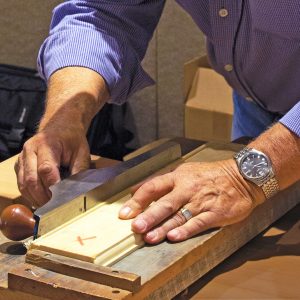
Rob Hanson of Evenfall Studios now offers a custom shooting board of his own design that is well-made, accurate and easily fine-tuned for your work. Sawmaker Mike Wenzloff (of Wenzloff & Sons fame) loaned me his Evenfall shooting board to take it for a test drive. So for the last couple weeks I’ve been using it in place of my two standard shooting boards. I am quite impressed.
Before I discuss the Evenfall shooting board, let me say a word about mine. I’ve used my shooting boards for many years and have a few gripes about them. My miter shooting board is made using maple. And though it’s a sturdy thing, the maple moves with the seasons, and so it feels like I’m always tuning it. This is one instance where I definitely prefer plywood to solid wood.
With that lesson in mind, I rebuilt my standard 90Ã?° shooting board about five years ago with some changes: Baltic birch plywood, a fence that can be tweaked slightly if necessary and sandpaper on the fence to grip my work so it doesn’t slide around. I’ve been happy with this shooting board, but it does straight cuts only. No miters.
The Evenfall Studios shooting board replaces both a standard shooting board and miter shooting board. Or, if you are one of those people who built mitering accessories for your standard shooting board, this shooting board replaces all those additional angled shims.
The Evenfall shooting board is a nice size with a working platform of about 12″ x 12″. The entire product is made using Baltic birch and sensibly finished. The platform is sanded to #150-grit. The chute is sanded much finer to reduce friction in this area.

The biggest innovation with this shooting board is its fence. The fence locks to the platform using two brass cap screws that thread into steel T-nuts embedded in the platform. You can adjust the fence for cuts at 90�°, 15�°, 22-1/2�°, 30�°, 45�° and 60�° angles (which is more angles than most woodworkers need).
The beauty of the fence is that you can adjust it minutely to get it exactly where you want it and the lock it down so it stays put. This means that you need some sort of way to position the fence. The manufacturer recommends inexpensive plastic drafting triangles. If you have an angle protractor, that also will work.
I found the adjustments to be easy to perform and , more important , the fence doesn’t move in service.
In addition to the clever fence, the shooting board has an excellent little kerf cut in the chute that collects dust and improves your accuracy. The relief it offers in that corner prevents your plane from tipping from a build-up of sawdust , a common malady among shooting boards.
The only modification I would make to the Evenfall would be to add some sticky-back sandpaper to the fence. I have been well pleased with the way it improves the fence’s grip.
If you lack the time or desire to build your own shooting board, the Evenfall product is excellent. It’s certainly better than either of my shooting boards, and it takes up less space, too. While I think it’s a good exercise to build your own shooting board, not everyone sees it that way.
The Evenfall shooting board is available directly from the maker for $120 in either left- or right-handed models. Accessories, such as a higher fence, are also available. You can read more details about it on the Evenfall Studios web site.
– Christopher Schwarz

Looking for More Woodworking Information?
– Sign up for our newsletters to get free plans, techniques and reviews HERE.
– Looking for free articles from Woodworking Magazine? Click HERE.
– Like hand tools? Read all our online articles on hand work HERE.
– Want to subscribe to Woodworking Magazine? It’s $19.96/year. Click HERE.