We may receive a commission when you use our affiliate links. However, this does not impact our recommendations.
 Exclusive for Popular Woodworking newsletter subscribers! Enter your email address in the box below for a free digital guide to the lumberyard. It will help you select the straightest, highest-quality boards. You’ll also receive e-newsletters from Popular Woodworking and select partners, crammed with great information.
How to Straighten Warped Wood
Someone once said, “The toughest advice to follow is your own.” I am tooling and lumbering up for some furniture projects this year, and while thinking about how to straighten warped wood or bowed wood (step one of any project involving rough-sawn boards) I started daydreaming about the world’s largest power jointer. I even included a power jointer in my list of basic woodworking tools. The only problems with this are:
1) There is no power jointer for the home shop that’s large enough to flatten the faces of most boards you want to work with.
2) Even if such a machine did exist and could be acquired for a reasonable price, I’d be going against my own advice if I bought one.
That advice is to always try to use the tools you already own for the job at hand. I’m sitting here looking at a serviceable wooden-bodied jack plane already in my possession, and that’s the tool I should use to flatten my rough-sawn boards.
After flattening one face of any board, you can put the board right into your thickness planer (which I still believe is a nice machine to have) and flatten the opposite face. Smooth both faces and you’re ready to rip.
Since I don’t have a massive workbench with a variety of workholding possibilities, I’ll be using a puttering bench that is braced against a concrete wall – to which I will need to add something like an oversized bench hook for completing the initial surfacing with my handplane. That’s all very cheap to do.
I pulled some tips from a Christopher Schwarz video to help me (and you) straighten lumber with this method.

1. Place the board on your bench and determine whether it has twist. The best way to do this quickly is with a pair of winding sticks. Sight along the length of the board, looking for level sticks. If the sticks form an “X” as you look down the length of your workpiece, that means the piece has some amount of twist.

2. Remove any twist by jack planing diagonally along the high line of the board.

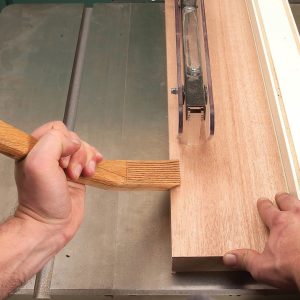
3. Use one winding stick to determine whether your board is bowed. Simply drag the stick down the length of the board, looking for daylight in the middle or along the two sides.

4. Remove any bow or cup in your board as follows:
a. If the board is low in the middle (technically, cupped), take cuts across the width to remove the high points along each edge. Do this all along the length of the board.
b. If the board is high in the middle (bowed), take cuts along the middle length of the board in order to create a piece that is low in the middle. Then go to “a” (above) and complete the flattening process.
Clear as mud? Buy the original Chris Schwarz video, one of our “Best of 2013” products, and learn from the master! The only thing he won’t teach you is how to follow your own advice.
–Dan Farnbach
Exclusive for Popular Woodworking newsletter subscribers! Enter your email address in the box below for a free digital guide to the lumberyard. It will help you select the straightest, highest-quality boards. You’ll also receive e-newsletters from Popular Woodworking and select partners, crammed with great information.