We may receive a commission when you use our affiliate links. However, this does not impact our recommendations.
 Nice fitting drawers are one of my favorite parts of making stuff out of wood. There is nothing like the appearance of even and minimal gaps and nothing like the feel of an easy sliding drawer that won’t get stuck when the seasons change. Meeting both goals at the same time is a challenge, but it’s a challenge worth meeting. In theory, you can make every piece perfect, both in the case opening and the drawer, assemble carefully and all will be well.
In reality, wood moves, little errors accumulate, and perfection is elusive. That doesn’t mean you can’t have nice looking, nice sliding drawers in a reasonable amount of time, it just means you need a logical process to work with the materials, tools and skills at your disposal in an efficient way. I have found that fitting each piece of every drawer to the opening it belongs in as I make the parts changes fitting from a mystery to a straightforward process. I start by making the fronts to the size of the openings, then planing the edges and ends down to where they just slide in to the opening. Eventually the front will be a bit smaller, but that’s the goal for now.
 When the fronts fit, it’s time for the sides. Because this cabinet has a bunch of drawers, I put the carcase on a cart so I can make camp close to the tools I need for each step. I cut the sides to about 1/16″ wider than the openings are tall and about 1/2″ too long. Then I head to the joiner where I set the infeed table to take a 1/32″ cut.
In theory, two passes will match the opening and a final pass will let it slide in with just the right clearance. In reality it gives two straight and square edges and a good place to start fitting the sides. Again, I’m fitting each piece to a specific place in the box, so I mark everything with a crayon. I use big letters and a red crayon because it’s easy to mix parts up. It’s a lot of writing but that’s better than going back to replace a bad part.
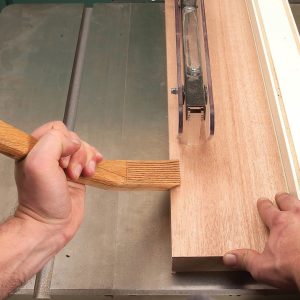
 This could all be done with a plane, working my hand, but for me using the joiner makes the process faster and more predictable. The machine doesn’t take away the ability to tweak things. In the picture at left, I’m tapering one of the sides from front to back to match an opening. I made a cut about half way in the length, then carefully backed the piece out. For the next pass, I push down on the front edge to start the second cut. That makes a neat, predictable taper and I sneak up on matching the sizes of the sides to their openings in bites of 1/32″.
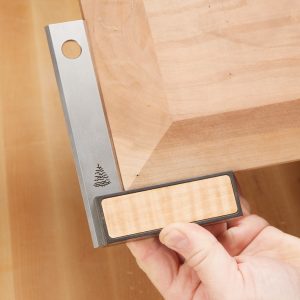
 The picture at right shows the goal for this step. The side moves in and out of the opening without getting stuck and the rule on top of the drawer side is 1/32″ thick. The eventual overall gap may be more or less, but I’m in the neighborhood I want to be in and I know that if something sticks later on, it won’t be because the sides are too wide.
There are a bunch of variables in fitting a drawer, and if you can eliminate them one at a time, you’ll have less investigating to do if the assembled drawer doesn’t look or move the way it should. At this point I know that three of the four parts to the drawer fit the way they are supposed to in the opening. The next step is to join the front (that I know will fit) with the two sides (that I know will fit) together without mixing up any of the parts. When the drawer goes together, the bottoms of the sides will run on the case, but the bottom of the front needs a slight gap. Life will be easier if you can accomplish that when you put the two pieces together.
 In this piece I’m using Greene & Greene style finger joints at the front of the drawers. When I cut the joints I cheated the bottoms of the fronts up a bit, and left a minimal amount of the fingers on the drawer fronts proud of the drawer sides. If all goes well after glue-up the gaps at the sides of the drawers will be just a bit bigger than they were with the fronts alone. If something should go wrong, I can still plane down the side of a drawer if I need to. I dry fit the front and the sides and check the fit in the opening. Because I cheated up on the joint at the bottom, the top of the drawer front should smack into the top of the opening. Planing the top down to the level of the top of the sides will take care of that, and if there is some misalignment in the joinery, working with the gap between the top of the drawer front and the bottom of the opening will make things look alright.
 I tinker with the fit of the dry-fit sides and opening until I’m happy with the way these three parts go in and out of the openings. Things can (and should) be a bit tight at this point. In between some of the steps here I’ve made some recesses in the fronts for pulls, and I’ve rough cut the pulls and fit them to those openings. You’ll have to get our December 2013 issue to read about that step (Click Here to Subscribe to Popular Woodworking Magazine).
The backs fit into the sides with through dovetails. Knowing how the sides and fronts fit before making the backs gives me some options I might not have otherwise. I can move the baseline on the pin boards down a hair and make the drawers taper just a bit in width from front to back. That will keep the drawers sliding easily in the future without opening up the gaps at the front of the drawer.
 After the joints are cut at the back, I dry fit the parts (so far). If the joints aren’t sloppy I can plane down the pins I left just proud of the sides. Then it’s back to the opening again to check the fit. If something gets stuck, I can be pretty sure that the problem lies with the joinery at the back of the drawer and correct it before moving on.
This might seem like a tedious way to go about this, but it makes it all a rather simple and straightforward process. It beats getting to the end of a project with a half dozen drawers that don’t quite fit and no idea of where to start removing the little bits of wood that are getting in the way. It’s nice to go into gluing the drawers together with the knowledge that they will slide neatly into the openings.