We may receive a commission when you use our affiliate links. However, this does not impact our recommendations.

The first time I saw a chisel plane was at an antique market in Kentucky. It was sitting out on a table with a bunch of common planes. Every person who walked up to the table picked it up to check its price tag, but the seller knew what he had. The original Stanley No. 97 “Cabinet Makers’ Edge Plane” is a fairly rare bird.
It turns out that wooden-bodied chisel planes are also uncommon, according to John M. Whelan’s essential book “The Wooden Plane.” As a result, I’ve always been a bit skeptical as to how useful the form is.
One user told me that he used it for trimming plugs flush to the surrounding surface. I haven’t had much luck with the plane for this purpose. Most of my plugs are a tough species, such as oak. And no matter how closely I saw them, there’s still too much wood there for me to pare with a chisel plane. Instead, I’ve had far more success using a plain old smoothing plane for trimming plugs flush.
Lately, however, I have found a few instances where the chisel plane earned its keep.
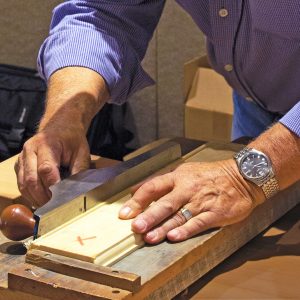
– Fairing one surface to another. Recently I had to extend the slot on my bench’s top to install some new vise hardware. I sawed out the waste and then used the chisel plane to bring the sawn surface into the same plane as the existing slot. It worked brilliantly. The sole of the chisel plane rode the existing slot and pared the face grain with ease. And because there was no mouth on the tool I could work right up to the end of the slot. This operation could have been done with a paring chisel, but it was much easier with the chisel plane. Similarly, the chisel plane helps me fair up the corners of rabbets after I’ve chopped out the waste with a chisel. Again, this can also be done with a chisel, but the chisel plane makes for tidier results.
– Removing glue. I’ve been turning to the chisel plane to remove the globs of glue that remain after a panel glue-up. I pare these globs away by working across the grain. The chisel plane works well at this because it doesn’t have a mouth. When I’d do this with a block plane, softer globs of glue would get squished by the tool and make a mess of things. I also prefer the chisel plane to a glue scraper because it is less likely to damage the panel.
– Removing finish sags. When I get sags on my film finish, I like to cut them away before adding another coat. I used to use an old block plane iron for this, but it can be hard to hold on vertical surfaces. The chisel plane makes quick work of sags.
In the end, I don’t think the chisel plane is an essential tool for your kit , all of the operations above could be handled by other edge tools. But they are handy. If you have found a good use for your chisel plane, I’d like to hear about it, and so would other woodworkers. Post a comment and let us know.
Christopher Schwarz