We may receive a commission when you use our affiliate links. However, this does not impact our recommendations.

When I inspect an antique tool – especially one that hasn’t been messed with much – I always take a look at the cutting edge. How was it sharpened? What is the shape of the edge? Did they do any work on the unbeveled face of the blade.
Usually, the edges of most vintage tools are in rough shape, even if they are free from rust. The edges are dull. The bevel usually has what I solicitously call the “multi-bevel” because it has been sharpened at a lot of wacky angles.
In fact, some woodworkers have concluded that most craftsmen of yore didn’t obsess much about sharpening, especially when it comes to maintaining the backs of the tools.
So when I got the privilege of inspecting the famous tool chest of Henry O. Studley of Quincy, Mass., I inspected every cutting edge I could get my gloved hands on. I looked at every chisel and plane edge in the chest.
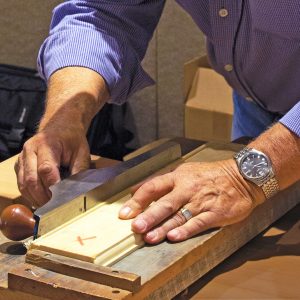
Let me tell you this: Mr. Studley was a fastidious sharpener. All of the backs of all of the tools were lapped flat up at the working area – though not to a mirror polish. The accompanying photos and video show some his work – we don’t think these tools have been tampered with much. I took these images with a raking light so the scratches look deeper than they really are.
— Christopher Schwarz
Want to learn to sharpen without all the bull pucky? Then you might be interested in my latest DVD “The Last Word on Sharpening.” In it I try to distill everything I’ve learned about this simple skill into a DVD that allows you to understand and master any system. You can purchase the DVD in our store.