We may receive a commission when you use our affiliate links. However, this does not impact our recommendations.

Sometimes it seems like there are 100 things that can go wrong with a handplane before it will do one thing right: Eject a perfect and fluffy shaving.
Lately I’ve been using a lot of bevel-up planes on softwoods and have become attuned to some of their peculiarities. Maybe I’m the new dumb kid on these issues; if so, then this blog entry will just be a note to myself.

Dust and Clearance Angles
Though we handplane users boast that our tools don’t make dust like a power sander, I think we all know that’s not really true. Planes make a very fine dust , they just don’t make enough of it to send you home hacking and digging things out of your nose that look like props from a Roger Corman movie.
This dust builds up on the work and on the tool and, in my experience, can become a problem, particularly with bevel-up tools such as block planes, some miter planes and the ever-popular bevel-up smoothing planes.
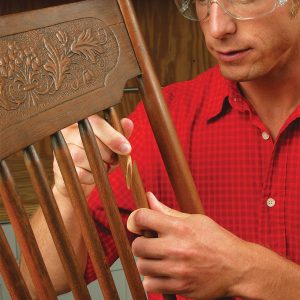
Here’s what I’ve found: This fine dust builds up behind the cutting edge and the back of the tool’s throat (see the photo at the top of this entry for an example). Surely this part of the plane has an anatomical name (like toe, heel, throat, cheeks etc.). So I will name it the plane’s “uvula.” Dust builds up in the uvula and , left unchecked , it will make bad trouble.
Here’s why: In a bevel-up plane the uvula is smaller than on a traditional bevel-down plane. The bevel-down planes have a huge drive-a-Vanagon-through-it uvula. The bevel-up planes have a petite micro-uvula.
When enough dust builds up, the tool tends to stop cutting until you clear out the uvula. Why? I think the dust makes the plane violate the tool’s clearance angle. In essence, the dust interferes with the cutting action. In a plane that is working well, the iron compresses and then cuts the wood’s fibers , then the remaining fibers spring back into the uvula. If you’ve got no uvula, the fiber springback from the wood pushes the iron out of the cut.
Am I full of potted meat in a round, sheet format? Perhaps. But clear your uvula next time and drop me a line.

Running Over Dead Bodies
Nothing fouls a plane’s mouth faster than trying to plane over an errant shaving on your work. The shaving crams in the mouth and tool stops cutting.
This is why I’m careful about shaving ejection. When I can, I’ll nudge the shavings into the garbage can at the end of my bench at the end of a stroke. Or I’ll skew the plane a bit and use my pinky to snowplow the shavings away from the sole.
If my shaving is thick enough it will spill out onto my left hand, which I’ll shift to direct the shaving someplace where it won’t get re-planed.
A Big Mouth
Some planes get clogged when they have an open mouth and are taking a fine shaving. The shavings build up in the mouth and get pushed down and out the mouth and into the path of the blade. Then the mouth is instantly fouled like when you run over a shaving.
So a tight mouth (just a bit wider than a typical shaving) is an asset. A big mouth will generally get you in trouble in planing (and in life).
– Christopher Schwarz
Looking for More Woodworking Information?
– Sign up for our newsletters to get free plans, techniques and reviews HERE.
– Looking for free articles from Woodworking Magazine? Click HERE.
– Like hand tools? Read all our online articles on hand work HERE.
– Want to subscribe to Woodworking Magazine? It’s $19.96/year. Click HERE.