We may receive a commission when you use our affiliate links. However, this does not impact our recommendations.

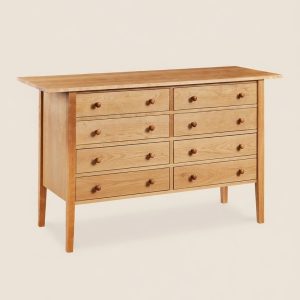
The form is simple. The jig was massive … but that’s another story.
Here’s what I like to see when I look at something I’ve built, something someone else has built or someone in the process of building. Ease. I like to see the simplified result – in form, product or technique – of what I know is not so simple.
I don’t mean it has to be modern, and I don’t mean it has to be pure (whatever that means). What I’m saying is that I love the pared-down thing. If it’s a process or activity I’m observing, rather than a product, give me only the necessary motion. Give me the casual but effective moves of a pro ballplayer at the annual family reunion game. Woodcraft, at its best or by the best, is like that. Even static objects will come alive when their lines are easy to follow with the eye and brain.
The teacher I had in the production cabinet shop told me to always do the hard part of a build first. That takes some discipline, though when a deadline and money are involved, you learn that it’s by far the most efficient practice. For the hobbyist, it’s often harder to acquire that discipline because it’s more enjoyable to complete a series of basic, habitual woodworking moves than to take on a difficult project or technique. Also, in your typical garage shop, there aren’t five other cabinetmakers standing around to offer tips, ideas and the occasional well-meaning jab.
In any case, whether you’re a hobbyist or a professional, the questions are: How do you make this stuff look easy? And, how do you know when you’ve reached that level of success?
The second question is probably impossible to answer. Hemingway’s famous quote on writing was, “We are all apprentices in a craft where no one ever becomes a master,” and I think some of that applies to woodworking. But the first question is something we can tackle. How do you go about simplifying a design or a job? Who are the teachers and writers that do it for you? And, when it comes to finished products, what do you like to look at? What are the forms or styles that appeal to you?

Frank Klausz makes dovetails look easy.
For me this week, it’s Frank Klausz on dovetails. I like looking at the ones he’s done, and I like his simplified approach to cutting them. Share your current favorites in the comments section, or by e-mailing me.
p.s. – we have Frank Klausz’s writing in our store, if you’re interested. There’s a nice joinery book available in both digital and print formats. Visit the product page and consider picking up a copy.