We may receive a commission when you use our affiliate links. However, this does not impact our recommendations.
Just got this month’s PW and in it was a letter to the editor about preventing rust. Megan answered saying use was an excellent means of rust prevention, regular oiling, and for long term storage, petroleum jelly is a good idea. All good answers, but in my opinion, missing a few details:
Climate control:
If you have a humid shop, you are going to get rust. So control your humidity! Consider using a dehumidifier (basically an air conditioner) to control the humidity in your shop, even when you’re not working there. Expensive you say? Let me ask you: How much did you pay for that set of Lie Nielsen chisels again? What about your planes? Wenzloff saws? Carving tools? Antique moulding planes you paid extra for because they were in good shape? How long did it take you to find that pristine bedrock #8 again? You get the message. If you have nice tools, you have to take care of them. You may be surprised how little it costs to run a dehumidifier.
Micro climates:
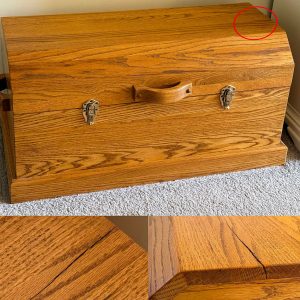
Air conditioning the entire shop isn’t the only way to control humidity. Consider creating a micro-climate – a shop within your shop. That’s right, maybe it’s time to build yourself a toolchest. I know wall racks are all the rage. You can display your tools like the Lee Valley Booth at Woodworking in America. But an old fashioned toolchest with a tight fitting lid goes a long way to controlling humidity. Why? Because you can create a micro climate inside it, different from the climate outside. Add silica jell packs that came with your new shoes, Lee Valley sells them as well, or a Goldenrod. A Goldenrod is nothing more than a heater that keeps water vapor from condensing on your tools.
Or consider moth balls. Camphor or moth balls give off a gas that interferes with oxidation. Corrosion inhibiting paper does something similar. I think both of these work best in hermetically sealed environments. If you have a set of center bits you use infrequently or hope to sharpen next year, drop them in a zip lock bag with a moth ball. It’s not a guarantee, but it will help.
Keep a clean shop:
We know that household dust and wood dust are hygroscopic – they absorb water. So dusty tools will likely corrode faster than clean tools. Using tools is a good way to keep them clean, as Megan mentioned. But there are other things woodworkers should do.
1) Never put a plane away with shavings in it’s mouth. That’s just asking for trouble. And don’t blow the shavings out like I do. Our breath is very humid. Clean them out properly. Yank out the blade and wipe it on a strop or oily cloth.
2) Forget Schwarz’ hybrid woodshop. Hand and power tools don’t mix. Kelly Mehler has a machine room to die for, but the hand tools are upstairs. If you must use sanders or planers in the same area as your hand tools, consider storing them elsewhere (I think a toolchest makes an awesome coffee table for the living room). Or listen to Kelly. We’re killing ourselves with wood dust. Spend some cash on a high quality dust collection system. (Kelly’s filters to half a micron) We’re willing to spend big money on tools that will hurt us and unwilling to spend on tools that protect us (Safety glasses, good dust masks, dust collection systems, saw stop, etc).
Coatings that help and coatings that don’t:
No one rust prevention coating will work for all situations. A thin film of a non-oxidizing oil (mineral oil, 3-in-1 oil (mineral oil), Starrett precision tool oil (mineral oil) , or Norton’s special honing fluid (mineral oil)) is an excellent rust inhibitor. Two other slightly controversial choices are motor oil (I like Mobil 1 synthetic oil because I use it in my cars and it doesn’t gum up over time) and WD-40 (see Brownell’s test here) But in dusty environments, oils will also attract dust which we know leads to rust. There are spray on rust inhibitors like Birchwood Casey’s Dri-touch or Boeing’s BoeShield T-9 which dry to form a waxy surface that doesn’t attract dust so readily. Getting sprays to really cover can be an issue. Ditto for heavy greases like petroleum jelly or cosmoline. But grease is a simple, effective, and inexpensive way to protect your tools. Just apply it liberally and protect the surface from contact with dust, wood, etc.
Recapping, if rust is a concern (and it should be):
1) Control the humidity first. Add air conditioning to the shop, run it even when you are not in it. Or build a traditional toolchest and control the humidity inside it.
2) Control the dust in your shop. Use a HEPA filter on your vac, store your hand tools elsewhere if necessary. If you thought dust collection was a luxury item, reconsider for the sake of your tools if not your own health.
3) Coatings are not a panacea and they shouldn’t be your only effort to inhibit rust. Rather, choose coatings based on the sort of storage: long term, no use, consider grease, short term, high use, paste wax, mineral oil, or WD-40. Consider how easily they are applied and removed (watch out for coatings containing Silicone which is known to interfere with certain finishes and glues).
4) Last, know that no single right answer will serve everyone. Each situation is different, each person is different. Some of us have a bit more corrosive perspiration that others. Rust can only be kept at bay by a concerted effort involving regular treatment, and environmental controls. Fortunately, these controls will make your shop a nicer, safer place to work. And now you have one more excuse to start building that traditional toolchest you’ve been wanting to build.