We may receive a commission when you use our affiliate links. However, this does not impact our recommendations.
 After Popular Woodworking in America, my desire to get back in the shop was insatiable. As soon as I returned to the office and caught up on work, I found my way to the shop to finish my Dutch tool chest. The first step was to create the tongue-and-groove joints for the back.
After considering my options, I landed on using the table saw. In my first year as a furniture maker, I spent most of my days ripping boards and cutting grooves on a Delta Unisaw from the ’80s. On top of teaching me to respect the machine, it gave me a love for the table saw.
I’m going to try my best not to turn this post into a love song for the table saw. So let me just say it once: I love the table saw. I know it is loud and terrifying. But I love it. When you respect the machine and learn to use it properly, it can become the most versatile machine in your shop.

Excuse my crude drawing, I’m no Yoav Liberman.
Since the boards for my back were 3/4″ and the kerf of the blade is 1/8″, I measure to the middle of my board thickness (3/8″) and the made two lines 1/8″ out from each side of that line (shown above in my crude drawing).
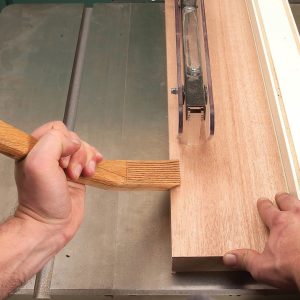
This showed me where I needed to place my blade on each board to run the groove on one side. Once I set the table saw fence so that the blade fit inside the line of one of the 1/8″ slots, and the blade depth at 1/4″ (I wanted 1/4″ tongues), I could simply run the board through the table saw with the edge down and the face against the fence. After running the board through the first time, I just needed to place the opposite face against the fence and run it through again – two 1/8″ cuts made a 1/4″ groove.
To cut the tongue on the table saw, I used the same measurements but this time set the saw fence so that the blade runs on the outside of each of my 1/8″ marks. Then I put the face of the board on the saw’s table with the groove edge against the fence (keeping the blade depth at 1/4″), and cut the excess wood from the groove.
I know there are so many ways to cut tongue-and-groove joints, and some woodworkers may turn their noses up at using power tools to build a hand-tool chest. But I am a firm believer in leaning into what you are good at. I am good with power tools and still learning at hand tools. I want to learn more and get better every day with hand tools, but I don’t think I will ever be able to completely shed the professional cabinetmaker mentality from my approach. I’m OK with that.