We may receive a commission when you use our affiliate links. However, this does not impact our recommendations.
The furniture I grew up with was a mix of Shaker style furniture and mid-century Scandinavian (direct from Sweden, where my folks lived in the 1970s). The woodwork and cabinetry was American Victorian from around 1900, along with some very cool egg-and-dart moulding that impressed me as a kid. So, it was eclectic enough – but somehow we skipped Arts and Crafts furniture.

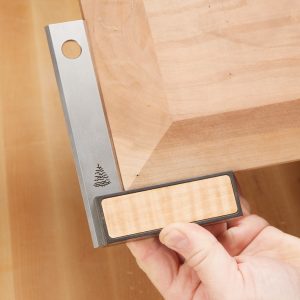
Gustav Stickley’s mark.
Perhaps our eyes are trained at an early age. For whatever reason, and despite the style’s ubiquity, I continued to skip or ignore Arts and Crafts furniture for years. I actually did not know much about Stickley, Limbert and their cohort until beginning to read some of Popular Woodworking’s material on them. Judging by the upcoming title list, next month is going to feature some new works on the Arts and Crafts style. The more I look at the techniques and products, the more I like it.
This morning I started reviewing a new book – “Building Classic Arts and Crafts Furniture,” by Michael Crow – and one passage on Charles Limbert’s marketing material jumped out at me. Crow says that “Limbert traced the roots of Mission furniture from the Spanish west, back to Spain’s commercial ties with Holland. The Spanish took their familiarity with Dutch furniture with them to the Southwest, interpreting those forms through the materials and tools available to them in the New World.” Crow goes on to explain that Limbert’s ideas may or may not have been verifiably true. As a marketer, Limbert was prone to inventing history.

The “New Mexico” Arts and Crafts style bookcase that my uncle and I made together.
I guess I’m more old-fashioned than Limbert, in that I prefer truth to fiction in marketing, but the statement about Mission furniture’s ties to Dutch furniture was nonetheless intriguing. I recently got to do a little woodworking with my uncle in New Mexico (see the resulting bookcase at left). It was his shop, and my uncle is used to calling the shots, so he designed the piece in his habitual style and in a material he had on hand, white oak. Several things about the project were pleasantly surprising, and maybe I’ll write more about it at a later date. What interests me now – in light of Crow’s quote – is that the style was essentially Mission or Arts and Crafts, but it tied in nicely with the continental European styles I’m more accustomed to making. It also fit really well with the mid-century stuff that the recipient, my sister Amy, had placed in the same room. So for the first time, I think I saw at least the outline of the transitions that are embodied in the Arts and Crafts furniture style. Arts and Crafts bridged the gap between continental and American, and between early 20th-century and mid-century.
My opinion is that it’s worth making a few pieces in the Arts and Crafts style even if you are more into the styles that came before and after, or if it has been a while since you built a piece of Arts and Crafts furniture. Try Bob Lang’s latest collection on for starters.
–Dan Farnbach