We may receive a commission when you use our affiliate links. However, this does not impact our recommendations.
I’ve been turning for about seven years now and have completed hundreds of objects ranging from table legs to large bowls to tiny bottle stoppers. Yet I’d never undertaken a large-diameter (in this case 24″) turning, and frankly, I was a bit anxious about it. Turns out it wasn’t nearly as tough as turning a 12″-diameter bowl blank, especially when you start it and the 20-pound chunk of wood is totally out of balance.
My walnut tabletop blank is from a recycled 32″ square coffee table that I made nearly 30 years ago. Over the years, it got rather beat up so I decided to transform it into something entirely different – a 24″ diameter end table – and it gave me a chance to try turning a relatively big top.
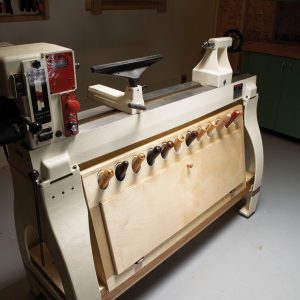
My Powermatic 3520B lathe can be set up to turn outboard. The headstock can travel up and down the length of the lathe bed. When moved to the end, the swing over the bed extension mounted below the normal bed is 30+ inches. My 18″-long bed extension came with a tool post accessory that raises the height of the tool rest to where it needs to be.
With regard to safety, the most important consideration when turning a large blank like this is securing it to the spindle. I used a beefy faceplate and six #12 screws that were 1-1/4″ long (the blank is a tad over 1-3/4″ thick). That was about the maximum length I could use given that my goal is to dish out the top to a depth of about 5/8″. Once the blank was mounted on the spindle, I was surprised by how rigid it was, especially when applying pressure near the outside edge.
While I’ve only had time so far to turn the outside diameter to a true circle and flatten the face (there was a bit of run out at the perimeter) I’d say the most surprising part of turning this big disc is how much actual material there is to remove, even when the cut is shallow. There’s just a lot of circumference to deal with.
This weekend I hope to get enough shop time to complete the turning. Oh, yeah: If you wonder about the series of holes drilled in the top, they are all done to the same depth so I can gauge the the depth of my cut across the face of the blank. It’s not easy to achieve a flat surface on wide turnings.