We may receive a commission when you use our affiliate links. However, this does not impact our recommendations.

The Classic Huntboard article in Popular Woodworking June 2009 (issue #176) includes traditional and non-traditional construction methods. The traditional methods involve mortise-and-tenon construction where the case back and sides meet the legs. That’s cross-grain construction.
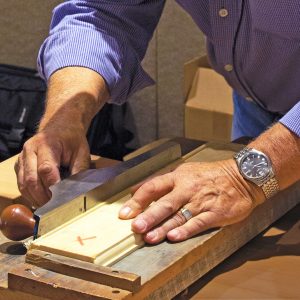
The photo on page 45 (shown above) shows how the joint is divided and the caption explains why. In the text, when the time comes to assemble the case, I write, “First, add glue to the leg mortises for the back, then spread glue on the tenons and slip the back into the mortises.” If you read this to assume that I add glue to all the mortises and tenons before I slip the joint together, you read it correctly. However, there are many woodworkers who don’t agree with that method. A synopsis of friendly e-mail exchange is posted below.
A reader wrote: “It’s entirely possible that I missed it, but I didn’t see any comments by Glen as to whether a reader should glue all three mortises on the case sides, or glue the bottom and let the top two float, or glue the top mortise, pin the bottom one (and elongate the hole in the tenon for the pin), and let the middle one float (this last option would be my choice). Obviously, this affects how the piece will age – if all three mortises are glued, it’s likely that the case sides will crack. While historically accurate, that result might greatly disturb some readers, especially newbies.”
My response was: “I’ve built many pieces of furniture (from huntboards to highboys and lowboys) that have case sides mortised into the legs. As a novice woodworker, I glued the sides securely into the legs without any thought of wood movement. You would think the case sides would or could crack given that arrangement. However, I have yet to see this happen to any of the pieces. Today I practice the same method , I fully glue the tenons and do not worry about wood movement issues and the possibility of cracks.
If you calculate the total movement of the sides of the huntboard, you’ll arrive at a maximum potential movement of around a 1/8″. It is my contention that the glues we use and the “give” of the woods are forgiving enough to counteract any movement. Add in the idea that most homes do not experience extreme changes in humidity and I don’t see this as an issue.”
OK, here are my thoughts on this issue. A board moves from the center outward when affected by seasonal changes. The middle mortise-and-tenon joint on the huntboard will not lose its hold. The top and bottom joints are the ones under stress as the wood expands and contracts. In accordance, the wood movement of 1/8″ overall is reduced to half , 1/16″ from the center of the board to the top and a 1/16″ from the center to the bottom. I believe the wood is resilient enough to handle this movement.
On a 36″ or wider tabletop that has breadboard ends, I work differently. I know the top is going to move. I’ve seen it happen over the course of a day or two, let alone during seasonal changes. In this scenario, I glue the center tenon joint and peg the remaining mortise and tenons after I enlarge the holes to allow for movement.
I asked Chuck Bender , a fellow woodworker with 30 years of furniture construction behind him , for his take on this issue. His answer was “In all these years, having made plenty of sideboards and huntboards, I can’t recall any that seriously cracked.” He glues the mortise-and-tenon joint fully and has experienced no major problems.
Chuck did correct me on one item though. His wrote, “During the ‘period’ the humidity levels ranged pretty widely but the change from the low to the high was rather gradual. In today’s homes, we can go from open windows and doors on an early October day with a reasonably high humidity to the next morning having the forced hot air system making the house 90Ã?° Fahrenheit with virtually no humidity. It’s that kind of nonsense that kills furniture.”
I have to agree.
Additionally, I think a bigger problem , and possibly the cause of case side cracks over and above the glue question , is how tenons are fit. If tenons are fit too tightly from top to bottom and, as a result, there isn’t enough room for expansion and contraction, your work is much more prone to issues such as cracks. As the wood moves and the glues creep, stresses build and something has to give.
Do you agree? Disagree? Let’s hear your take on this issue. Leave a comment. Also, if you a photo of a project you’ve built that has developed a crack, send me the photo and I’ll post it. There’s no better way to learn than from experience.