We may receive a commission when you use our affiliate links. However, this does not impact our recommendations.
 Perhaps the most important instrument for the hand-tool oriented woodworker is a sturdy workbench. A reliable bench is fundamental for the success of sawing, chiseling, planing, grooving, drilling and more. The heavier the bench the better, and a bench with plenty of holdfast holes is the best. But there are many situations where you will benefit from a small elevated clamping platform installed over your workbench – mainly when you need to have a workpiece closer to your shoulders and eyes. It’s also useful to have a “bench on bench” for clamping small workpieces that are too cumbersome to clamp on the main bench using a stationary vise or holdfasts.
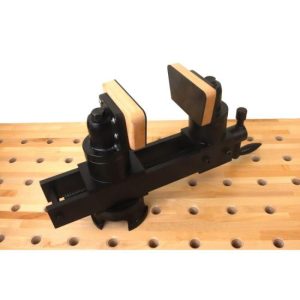
The Moxon Vise (Benchcrafted, Lie Nielsen, Texas Heritage, Tools for Working Wood, Lake Erie Toolworks…or make your own) is a good examples of an auxiliary clamping platform. So is the “Portable Workbench” that I built and wrote about for American Woodworker in 2014.

This is the “Portable Workbench” that I built a few years ago; it is feature in American Woodworker #171, April/May 2014.
Last year I built yet another “Bench on Bench” contraption that helped us tremendously with our 9th-grade box-making project. But I think it’s more than for just boxes – it can become your bench to take on a journey, a bench for the space-deprived woodworker (such as in a one-bedroom apartment or a college dorm), and is an inexpensive gateway bench to be gifted to friends and the children in your life.
The advantages of this jig are:
1. It can be clamped onto any flat surface such as a tabletop or a countertop, or you can put it in a bench vise to serve as a platform to work on other objects.
2. It allows you to comfortably clamp small workpieces for planing, ripping and crosscutting in a vertical or horizontal configuration.
3. It allows you to clamp narrow pieces by positioning two clamps from the jig’s inner face to facilitate grooving, dadoing and rabbeting. This is particularly important in cases where your bench does not have holdfast holes drilled into it. (See pictures)

Without holdfast capabilities, it is difficult to clamp a thin and narrow workpiece from the edge of a bench for wide chamfering, grooving and rabbeting. The clamps that hold the piece down will be in your way and the workpiece will hang too far out in space and might break or flex. To overcome these situations, we use our “Bench Bulls.”

But, before I start let’s name the jig. I thought a good name would be “Bench Bull” because of its “horns” and its steadfast functions, but another great name is: “Bench Mule.” As you can see, the jury is still out, but for now lets call it The Bench Bull.
A Bench Bull is inexpensive to build and requires as few as four F-style clamps to allow it to fully function.
In this entry I will show how to make use of a simple Bench Bull, and in following entries, I will show how to build a deluxe version that incorporates two pipe clamps or holdfasts.
The simplest way to build one is to cut a 2×4 board into a few segments and sandwich them together (see the drawings below). This can be done with a handsaw – and it’s a good activity to teach kids so that each of them will end up with a jig. If you have more time and lumber, and access to heavier tools, you can build the Bench Bull from hardwood, or cut it out from a massive beam.


The Bench Bull shape resembles an “H.” It should include a few holes (or gaps if you build it from 2×4 segments) in between the horns of the “H” to allow for convenient clamping along the back of the jig – in addition to the use of the horns.
See the pictures below to understand the Bench Bull’s full scope of advantages – and stay tuned. In my next entry, I’ll show additional Bench Bull designs.


A simple shop-made T- square is all you need to keep a workpiece put for planing.

The Bench Bull allows you to clamp narrow pieces by positioning two clamps from the jig’s inner face to facilitate effectively grooving, dadoing and rabbeting. This is particularly important in cases where your bench does not have holdfast holes drilled into it.