We may receive a commission when you use our affiliate links. However, this does not impact our recommendations.

Though I like to work out of a full-size tool chest (38” x 24” x 24”), it’s obvious that a chest like that would be too big for a job-site carpenter or for someone who needs to do only household repairs.
So during the 18th and 19th centuries, ironmongers offered a range of tool chests for the professional cabinetmaker all the way down to the lady of the house, according to “Tools for the Trades and Crafts” by Kenneth D. Roberts.
So in 1855, you might buy the Joiner’s Tool Chest, a 36”-long chest made from pine and lined with oak. If you were a serious home woodworker, you might buy the House Tool Chest, a 24”-long pine chest lined with oak. Old catalogs also listed “Warehouse Tool Chests,” which could be 21”-26” long. And sellers carried “Gentlemen’s Tool Chests,” which could be anywhere from 15” to 17” long.

These chests were all available with a set of hand tools included in the price – everything from a jack plane, chisels, a glue pot, saws and gouges. With the larger chests, you had enough tools to actually build simple pieces of furniture. Some smaller tool chests would come with a multi-tool – a fancy handle with a variety of tools that would snap into the handle. You could switch between awl, chisel, gouge, saw and gimlet with just the press of a button.
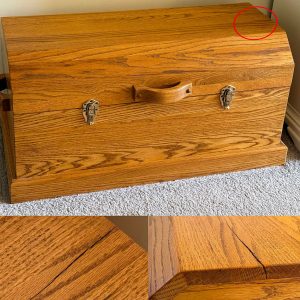
For the December 2011 issue of Popular Woodworking Magazine, Managing Editor Megan Fitzpatrick built a gentleman’s tool chest that is based on an example that I own. The chest I own was most likely built by its owner – some of the trim still bears imprints from its former life as a wooden fruit box. But the maker really wanted it to look like the fancier chests in the catalogs. He or she even applied a fake raised panel to the lid.

It’s a fun project to build for someone in your life who might have an interest in woodworking. You could knock the chest out in a couple days (it’s all nails and butt joints that are cleverly concealed).
And if you really want to give the recipient a push into the craft of woodworking, you could fill the chest with a small set of hand tools. Here’s one typical set from an 1855 book of tool engravings suitable for the gentlemen or “emigrant.” I wish I had this set when I started.
5 chisels (3/8” up to 1”)
Small and large hammers with cross-peens
Padsaw, 10” backsaw, 15”-long panel saw
4 gouges (3/8” to 3/4”)
A hatchet (every gentleperson needs a hatchet!)
Wooden mallet
Marking gauge
Nail pincers
6 gimlets
Glue pot and brush
Pliers
Jack plane and smoothing plane
Sliding bevel
Try square
Rasp, 2 files and sawfile
Oilstone in a box
2 spokeshaves
2’ folding rule
compass/divider
Iron crow (a small crowbar)
Drawknife
Striking knife
Three turnscrews
So be sure to check out the project in the next issue – it’s in the I Can Do That column.
— Christopher Schwarz
And if You Do Build the Chest for Someone…
Here’s a great (and inexpensive) idea for a book to give them: “Exercises in Wood-Working.” It’s a fantastic little book from 1889 that we reprinted last year (in hardcover and in the United States). It is an excellent place for beginners to start into the world of hand tools. I’ve done many of the exercises myself and often recommend this book (and it’s only $14.39). It’s available in our store.