We may receive a commission when you use our affiliate links. However, this does not impact our recommendations.

Last week I took my new Clifton No. 5 to teach a full-size toolchest class at The Woodworkers Club in Rockville, Md. Several of the students used it on their toolchests, which they made using cherry, pine or poplar.
The plane did quite well – the iron stayed sharp through planing up an entire case. As I mentioned in my entry on this plane last week, my only quibble was with the plane’s “Stay-Set” chipbreaker. The “Stay-Set” is a two-piece design that allows you to retain a chipbreaker setting during freehand sharpening.
The quibble was that the breaker shifted forward and back several thousandths of an inch. That’s irrelevant for most jack-plane work, but for a smoothing plane it can be important.
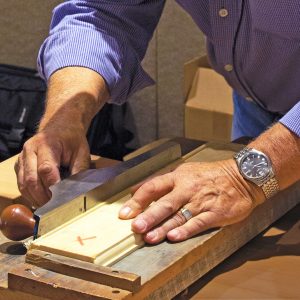
David Charlesworth (yes, despite reports to the contrary, David is alive and well) suggested a quick solution that I tried today. Using a small center punch on the main plate of the breaker, I deformed its slot slightly, tightening up the cap of the breaker so it did not move an iota.

It took three solid punches on either side to achieve the fit I wanted. On one side of the slot I went a little too far, so I used a needle file to reduce the slot to the proper width. In all, it took less than five minutes of work.
I also dug up one of the old Clifton “Stay-Set” breakers from 10 years ago that was in my bin of spares. That breaker had zero slop in its slot, so you should check your breaker before punching away.
More on this tool as I break it in.
— Christopher Schwarz