We may receive a commission when you use our affiliate links. However, this does not impact our recommendations.

When it comes to pushing our handplanes, I think we are candy-bottomed wussies compared to the joiners of the 17th century.
We are obsessed with how thin a shaving we can make. Early joiners, however, wanted to take the thickest, gnarliest shaving possible for the tool, the bench and his or her arms. For proof, take a look at the first English-language woodworking book, “The Art of Joinery” (1678) by Joseph Moxon.
Moxon says:
But if you ask me how rank your Iron ought to be ſet? I anſwer, If your Wood be ſoft, and your Stuff free, and frowy, that is, evenly temper’d all the way, you may ſet the Iron to take a ſhaving off the thickneſs of an old coined Shilling, but ſcarce thicker; whereas, if your Stuff be hard, or curling, or knotty, you ſhall ſcarce be able to take a ſhaving off the thickneſs of an old Groat. Therefore you muſt examine the Temper of your Stuff, by eaſy Trials, how the Plane will work upon it, and ſet your Iron accordingly. And obſerve this as a General Rule, that the Iron of the Fore-Plane is, for the firſt working with it, to be ſet as rank as you can make good work with; and that for ſpeed fake.
Allow me to translate. Take a shaving the thickness of an “old coined shilling” when the wood is easy to plane. Take a shaving the thickness of an “old groat” when the wood is tough.
Sounds great, but how thick a shaving is he talking about? About five years ago I started pestering collectors of old English coins until I got my answer. An “old coined shilling,” was likely a Commonwealth shilling, which was about .040” thick. An old groat was likely a Charles II groat, which was about .024” thick.
I published these numbers in my reprint of “The Art of Joinery” and didn’t give it much more thought until today, when I found a reproduction of an old groat in my desk. Some woodworker somewhere handed it to me; I honestly cannot say when or where. But something made me take the groat down to my shop to see if I could make a shaving as thick as this coin.

I measured the reproduction groat with calipers, which was about .040” thick.
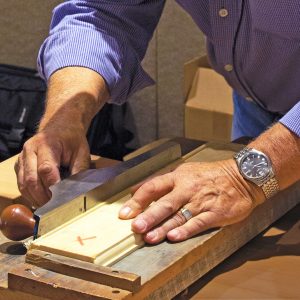
I began my experiment with some dry American white oak, which I planed with a heavily cambered jack plane. After traversing the grain, I couldn’t get anything thicker than .020” without jamming the tool in the wood or pushing the workbench across the floor.
That’s not nearly as thick as a (reproduction) groat, and I felt like a wus.
So I grabbed some tulip poplar from my wood rack and tried to see how thick a shaving I could manage with the same plane and with traversing. I got up to a .035”-thick shaving when the workbench began to back away rapidly from me. (This, by the way, is why I prefer my bench against the wall.)
But still, I was short of the .040” thickness, which is a fat 1/32”. That’s a lot of wood to remove in one stroke. And this made me wonder if I should perhaps start lifting weights, or perhaps the wood Moxon was talking about wasn’t fully seasoned, like mine is.
Time to start poking around the woodpile and to handplane some firewood.
— Christopher Schwarz