We may receive a commission when you use our affiliate links. However, this does not impact our recommendations.
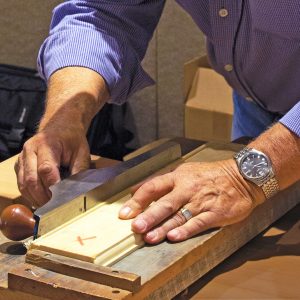
 Last week I posted my favorite table saw push stick. (By the way, I later added a full size pattern.) This week, I continue the theme with a push block for the jointer. I made the one in the picture 17 years ago when I started with the magazine. It’s seen a lot of use over the years and has a permanent home on the machine.
I know other woodworkers use a plastic device with a foam or soft rubber bottom and a handle on top. I think these can present problems, particularly when jointing longer boards that are not so thick. You’ll understand why when I describe my partiality to the one pictured here.
As the name implies, the push block is made to push rough lumber over a jointer to make a flat (not just smooth) surface on one face. The design of this push block forces me to push the stock forward with little downward pressure. There is some downward force, but not much and that force is always at the end of the board, not anywhere forward of the end. This design, therefore, prevents the possibility of pressing the board down to the jointer table. I don’t know about you, but I always start jointing a face with a bowed side down. If you press the bow out of a board, it won’t have a flat surface. It will spring back to it’s bowed shape as soon as the pressure is released. With the plastic-style push block, you must press down on the stock to get enough grip.
My technique for jointing a board is to push by hand from the end of the board until the end reaches the leading edge of the jointer infeed table. At that point I reach for the push block, hook the heel over the end and continue until the stock has completely passed over the cutterhead. This is, of course, why we use any sort of pushing device, for safety; keeping valuable body parts away from sharp steel moving at high speeds.
My old block is made from poplar, is about 10″ long and 3 1/2″ wide. Because the upper section runs cross-grain to the bottom, it’s joined with a tongue and groove. The upper part is shaped to be comfortable in the hand with my fingers over the top section. You can download the Push Block Drawing of you want one of your own.