We may receive a commission when you use our affiliate links. However, this does not impact our recommendations.

The little side-clamp honing guide is my favorite bit of sharpening equipment. But it frequently is criticized for two shortcomings:
– It is poorly made and sloppily painted. So you have to tune the little sucker up before it will perform reliably, especially with chisels. This is a 100-percent valid critique of this honing guide.
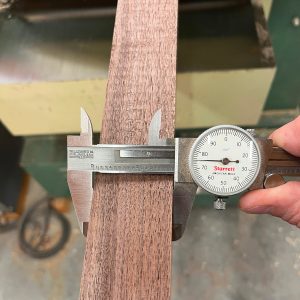
– You cannot rely on the honing guide’s directions for setting the correct angle on a plane iron , i.e. make the iron project 1-1/2″ to sharpen a 30Ã?° angle. This inaccuracy is because these instructions are based on using thin irons only, back when most plane irons were consistently about .08″ thick. Today many manufacturers use thicker irons.
This second criticism is also true. Thick irons produce different sharpening angles in the jig. But the question is: Is it true enough to bother a woodworker (who is not an engineer, machinist or nuclear physicist)? Back in April, Thomas Lie-Nielsen told me he had done the math and that the differences were minor , thicker irons didn’t change the angle much.
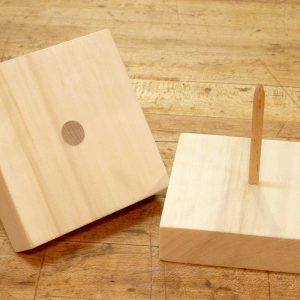
So this morning I decided to put some numbers to it. Yes, I know there is an equation that will answer this question, but I’m the kind of guy who needs to see it to believe it. So I built a little jig with stops that would set the iron in my side-clamp honing guide so the iron projected either 1-1/2″ out of the guide or 1-5/32″ out of the guide.

The stop for 1-1/2″ is supposed to set a .08″-thick iron at 30Ã?°. And it does. The stop for 1-5/32″ sets a .08″-thick plane iron at 35Ã?° , my other most-common sharpening angle.
Then I sorted through my planes and pulled out some thicker irons. I put each in the side-clamp honing guide, set them using the stops on my jig and then used the handy Grizzly G9900 Universal Dial Bevel to read the actual sharpening angle off the unbeveled face of each plane iron.
Here are the results:
1. A Veritas plane iron that is .123″ thick is at 32.1Ã?° at the 1-1/2″ stop, and at 37.3Ã?° at 1-5/32″ stop.
2. A Lie-Nielsen plane iron that is .14″ thick is at 32.4Ã?° at the 1-1/2″ stop, and at 37.4Ã?° at 1-5/32″ stop.
3. A Veritas plane iron that is .179″ thick is at 33.1Ã?° at the 1-1/2″ stop, and at 38.2Ã?° at 1-5/32″ stop.
4. A Veritas plane iron that is .19″ thick is at 33.4Ã?° at the 1-1/2″ stop, and at 38.8Ã?° at 1-5/32″ stop.
I’ll let you draw your own conclusions here, but here’s what this data means to me (a non-engineer and non-machinist): I shouldn’t worry about this too much.
For me, what counts is consistency more than precision. If my iron is always sharpened at 37.4Ã?° instead of exactly 35Ã?°, that’s fine by me. The 2.4Ã?° difference will not significantly change the way the plane performs. It will not violate the tool’s “clearance angle” (I’ll discuss the clearance angle another day).
In fact, what it will do is make the cutting edge just a teensy bit more durable (higher sharpening angles make for more durable edges) and it will increase my cutting angle on bevel-up planes just a tad , which also isn’t a bad thing (higher angles in those tools reduce tear-out).
My apologies for making this “Technical Tuesday.” Next Tuesday I’ll post cute pictures of hedgehogs.
– Christopher Schwarz
Looking for More Woodworking Information?
– Sign up for our newsletters to get free plans, techniques and reviews HERE.
– Looking for free articles from Woodworking Magazine? Click HERE.
– Like hand tools? Read all our online articles on hand work HERE.
– Want to subscribe to Woodworking Magazine? It’s $19.96/year. Click HERE.