We may receive a commission when you use our affiliate links. However, this does not impact our recommendations.

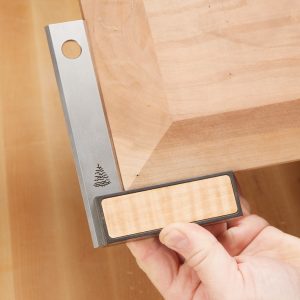
Inspired by Robert W. Lang’s article on making wooden try squares in the Autumn 2009 issue, I decided to make a batch of squares this weekend.
Yesterday at lunch I bought some quartersawn European steamed beech that was on sale at the local lumberyard. The clerk at the yard described it as “rustic,” which must be a local Ohio term meaning “crap.” I found one 12′ board in the whole stack that had enough straight material suitable for making layout tools.
The price was right ($1.25 a board foot). And after a lot of handsawing and bandsawing last night I squeezed out enough beech to make seven squares and two nice bonfires.
Then the fun began.
And by fun, I mean translating 18th-century French. I spent an hour poring over “Le Menuisier En Batiment,” one of Andre Roubo’s volumes on the craft. He wrote specific instructions for the dimensions of a “triangle,” which is what he calls a square. I translated those dimension to English and then to modern Imperical dimensions. A French inch (pouce) is equivalent to 1.066″ in modern imperial. Each French inch is further divided into 12 “lines.” Each line is equivalent to .088″ today. The French foot is 12.44″.
Then I checked Roubo’s account against the try squares in Benjamin Seaton’s tool chest. And surprise, Seaton’s small wooden square is almost exactly the same size as Roubo’s, though Roubo’s is fancier.

But there was one curious detail about Seaton’s three try squares. The text describing them says all three blades taper in thickness. One blade is described as tapering from 1/4″ thick to 7/32″. Because all three taper, I presume it was deliberate. But why?
To take some weight off the end of the blade?
To expose more end grain of the blade (sort of like in a coffin smoother or a traditional straightedge) to make the blade respond faster to seasonal changes in humidity?
Beats me. I drew up Roubo’s square in SketchUp and plan to make a few of the squares with tapered blades. If Roubo mentioned tapering, I missed it.