We may receive a commission when you use our affiliate links. However, this does not impact our recommendations.

Every Tuesday night we ritually torture our children with a meal that we call “New Food Night.” The kids have to eat something they’ve never eaten before , this week was coq au vin, but we’ve ranged as far as ostrich and bison. In exchange for eating the new dish, the kids get one U.S. dollar and a small prize, usually a small plastic animal.
After a couple years of this schedule my girls have become accustomed to it (or they are suffering from Stockholm Syndrome). But some nights are rough. The most difficult dinner of all was when I made homemade chicken noodle soup. Tears , enormous ones. Shaky bottom lips. Slumping in the seats to a horizontal position.
All for chicken, wide egg noodles, carrots, celery and broth.
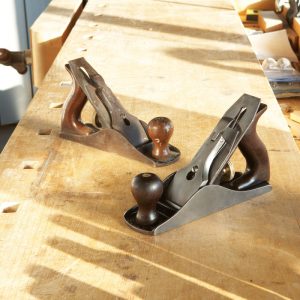
Every year I torture myself on Jan. 1 by forcing myself to put away some beloved tools and start using tools that I haven’t embraced. For 2006, I put away my traditional bench planes and used Veritas bevel-up planes: a jack, jointer and smoother. After 12 months of hard use, I’m glad I did it. I now know the limitations and advantages of these tools. First the bad: I still don’t dig the location of the adjuster (it’s too low) or the shape of the handles (which I can fix with a rasp). But then the good: I really like the low center of gravity. I also like how you can tighten up the mouth to admit one-half of a gnat’s hinder with little effort. And I really like how you can hone an ultra-high angle on the blade to make a plane that mocks interlocked, reversing exotic woods.
 So on Jan. 1 of 2007, I set the bevel-up tools aside and took out my Sauer & Steiner unhandled York-pitch smoothing plane. I have made peace with this tool and it is a great user, but I don’t grab it automatically whenever I need to do some general smoothing. Maybe I’m not familiar enough with the grip , there’s no tote on this plane. Plus, there’s no mechanical blade adjuster or lateral adjustment lever.
But whether the thing turns out to be chicken soup or coq au vin, this is its year.
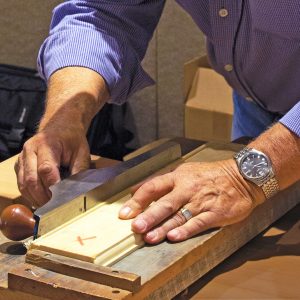
Its first major task was finishing up the top of this English Workbench for a photo shoot on Thursday. After completing the bench, I started building the accessories you need: bench hooks, a sticking board and some stuff that grabs round and octagonal work. The sticking board, which is designed for holding long, narrow work for shaping, is about 6′ long. When I placed it on the bench I noticed it wasn’t sitting flat on the top. At first I thought it was the sticking board that was bowed. But after jointing the sticking board again and checking everything with straightedges, I determined there was a hollow in the middle of the benchtop, right up at the front of the bench.
This is the worst place for a hollow in your benchtop. Period.
So I went to work with a jointer plane, working diagonally across the top both ways. Then I worked with the grain of the top with the jointer plane, and then with the Sauer & Steiner smooth plane. Sweet. I checked my work with feeler gauges. I did this out of curiosity , not habit. I get asked all the time how flat a benchtop needs to be for handwork. Until today my answer has been: Flat enough so your work doesn’t bow under planing pressure.
That’s not a good answer. So with the feeler gauges and the straightedges I determined that I shoot for a top that is flat in the critical working area (the front half of the bench) to about .004″ along 6′. Is that extreme? I don’t know. But that’s when my work started to behave predictably under the planes.
So is this a good start to the year? I don’t know. I’ll have to noodle it.