We may receive a commission when you use our affiliate links. However, this does not impact our recommendations.

During the Lie-Nielsen Hand Tool Event in our shop this spring, furniture maker Jeff Miller came over to my bench and started asking questions about the Wenzloff & Sons no-set backsaw I had hanging over my bench.
To demonstrate the saw’s superpowers, I cut a tenon with the saw. The amazing thing about the saw, based on the Disston No. 77, is that it leaves a perfect surface behind. And I mean a perfect surface. See my blog entry on the saw here.
The tenon I cut for Jeff was OK – not my best effort. But it looked a lot cleaner than most hand-cut tenons. Jeff looked at the tenon for a moment then walked me over the bench where he was demonstrating.
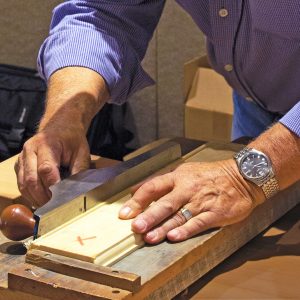
Clamped in a vise was the simple sawing jig shown in the photo above. Using careful measurements and shims, Jeff had dialed in the jig to work with one particular saw. He clamped a piece of work into the jig and within a few minutes he had produced a tenon that rivaled a router-cut tenon.
The jig is crazy simple. And with one extra block of wood, it can be used to cut the angled joints that Jeff uses in his chair work.
I immediately sought to sign him up to write an article on the jig for Popular Woodworking Magazine (more news on that soon, I hope). He also has an equally clever jig for cutting and paring the mortises.
This summer, Jeff is teaching a class up at Lie-Nielsen Toolworks on how to make and use this jig to do incredible precision work by hand. The class – July 30-31 – is in Lie-Nielsen’s new classroom space next to the factory in Warren, Maine. Details here. You can read Jeff’s syllabus here: http://www.lie-nielsen.com/pdf/Workshop_Miller.pdf
Jeff’s work is humbling. He’s an incredible craftsman, designer and patient teacher. And he’s one of those rare professionals who fully embraces handwork and machine work. His shop in Chicago looks a lot more like a traditional European shop than an American one. He has well-cared-for machines, plus heavy benches and lots of sharp hand tools.
If you can be in Maine in July, I think this is an excellent class if you seek to become a maestro at the mortise-and-tenon joint.
– Christopher Schwarz