We may receive a commission when you use our affiliate links. However, this does not impact our recommendations.

I’m passionate about cooking, but I don’t get excited about cooking equipment. I’ve got decent cookware, questionable Far East knives bought from an infomercial and (somehow) enough silicone basting brushes for the whole neighborhood. Want one?
But when it comes to marking knives for woodworking, I’m tough to please. Exhibit A is over at WKfinetools.com. I’ve probably had about a dozen marking knives pass through my hands during the last decade, and none has pleased me as much as the small knife from Blue Spruce Toolworks.
It’s the only knife that does everything I ask from a knife, from marking out skinny dovetails to making a coarse cutline for a crosscut handsaw. And I’ve written over and over how much I like it , perhaps to the point where you’re wondering if Dave Jeske at Blue Spruce is padding my secret account in the Cayman Islands.
So a few weeks ago, I got a small box from Steve Quehl, who runs the Woodcraft store outside Atlanta. In it was a new knife made by Bob Zajicek of Czeck Edge. It’s called the Kerf Kadet, and Steve offered to loan it to me to test in the shop.
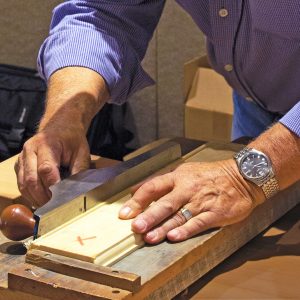
I used it to mark out the joints on a Gustav Stickley plant stand I built last month, and today I spent some time marking out dovetails with it. And I can safely tell you that Steve is not getting this knife back. The most he can hope for is a check to reimburse him.
The knife is similar in some ways to the Blue Spruce knife, but it has some significant differences that are worth noting. The Czech Edge blade is a bit narrower (5/16″ compared to 23/64″) and shorter past the ferrule (1-5/16″ compared to 1-1/2″). With those statistics, both knives will do most standard joint-marking chores.
Where the knives differ is in the handle and ferrule (the metallic transition from the blade to the wood). The Blue Spruce uses a smooth two-piece ferrule. The Czeck Edge uses a single machined bronze ferrule with three grooves turned into it. The grooves are not decorative. When you pinch the knife at the ferrule, the grooves improve your grip on the knife. I was surprised how much I liked the feel.
The wooden part of each tool’s handle is also different. The Blue Spruce has a somewhat vase-like shape that opens up at the ferrule. When I grip the Blue Spruce, I put my fingers behind this area, which prevents my fingers from slipping off the knife when I add downward pressure.
The Czeck Edge has more of a pencil-like shape and is lighter in the hand. Both are comfortable in my hands.
How about fit and finish? It’s impossible to beat Blue Spruce on this point, but the Czeck Edge is in a tie for first place. The knife is flawless. Crisp and smooth with a perfect transition from wood to metal. It’s what you would hope for in your own work. One other nice touch: The Czeck Edge knives come with blade guards for storing the knife. And the price? It’s fair: $37.95 to $41.95 depending on the wood you select.
I’m eager to put the Czeck Edge Kerf Kadet to some more use. Lucky for me I have a shop here at the magazine and a shop at home. So I really don’t have to choose favorites.