We may receive a commission when you use our affiliate links. However, this does not impact our recommendations.

I have a palm-grip random-orbit sander that I’ve used for many years on household projects that could not be planed because they were too big, such as 16’-long runs of base moulding nailed to a wall, or weren’t designed for handplaning, such as plywood that is covered in paper-thin veneer.
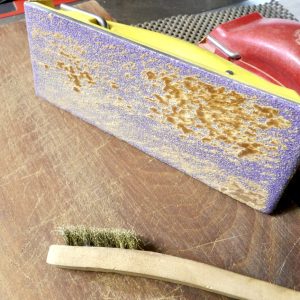
A couple years ago, the pad on the sander disintegrated as I was sanding some paint on a moulding. I shrugged my shoulders, put the sander away and finished the job with a sanding block.
Until this week, I’d almost forgotten that I owned a broken sander.
Then I started planing the “roey” mahogany grain on the drawer fronts of this Campaign chest I’m building. What’s roey grain? It’s a figure in the wood that is caused by repeated cycles of spiral growth in a tree that reverse left and then right, according to Bruce Hoadley’s “Understanding Wood.”
Here’s how I visualize it: Spiral grain is where the fibers of the wood spiral up the tree, like the stripes on a barber pole. Spiral grain is bad enough when it occurs in a mild domestic tree. The result is the grain will run one way on one side of the board’s cathedral and the other way on the other side of the cathedral.
Roey grain is a whole circle of hell worse. In a tree with a bad case of roe, the grain wraps around the tree clockwise for a year, then wraps around counter clockwise the next, back and forth.
The result is that the wood has an attractive striped figure when light reflects off it. It also makes the wood difficult to handplane. It makes you remember broken sanders and – after a couple beers – order a replacement pad for your sander.
My replacement pad came yesterday. I installed it on the sander and then put the little blue beastie back in its deep drawer. Why? The handplane of last resort.
I think every woodworker has a tool that was meant for him or her. It could be a junker, an infill or something between. But it is the plane that doesn’t let you down. For me, that plane is a little infill smoother I purchased from Wayne Anderson in 2006.
As far as I know I’ve never measured the bedding angle of the iron or the throat opening. The angle is kinda high and the mouth is kinda tight. It is a small tool, about the same size as a block plane, and it fits my hands like it was made for me.
But most of all, I cannot remember this plane letting me down. It always seems to be able to plane curly, roey, interlocked, whatever grain. Why? Was it anointed with the balms of forbidden trees? Did Wayne sell his sole/soul to the devil? Don’t know. But I keep its iron sharp and trot it out when I get backed into a corner.
Sleep tight little sander. This is not your day.
— Christopher Schwarz
For a detailed discussion of tear-out and its remedies, see our book “Handplane Essentials,” which covers it in detail. It also discusses infills — their realities and myths. The book is available in ShopWoodworking.com.