We may receive a commission when you use our affiliate links. However, this does not impact our recommendations.

Charles Hayward, the dean of woodworking writers, once wrote a column about the continued industrialization of the woodworking craft. All hand work was being set aside and forgotten. People who were once craftsmen were become machine minders.
In the end, Hayward noted, it will be only the engineers who will ever find real joy in work.
So I kid the engineers. Whenever I begin a class I ask all the engineers (and retired engineers) to raise their hands. I have had classes where 80 percent of the students are engineers. A typical class is about 40 to 50 percent engineers.
I warn the engineers that if they use a micrometer during the class I will go all Sister Slobenitz on their knuckles with a Stanley folding rule.
I mess with their heads when I insist that they make 3 micron-thick shavings with their handplanes. When they ask how much pressure to use when burnishing a scraper, I reply: 7.42 Newtons.
But the truth is, Hayward was right. Engineers are the people who build the modern world, whether it’s software or submarines. Engineers are the echo of the world of the pre-Industrial craftsman. They do find joy in work. In building instead of servicing or repairing or deep-frying.
Today was the second day of my “By Hammer and Hand” class at the Connecticut Valley School of Woodworking in Manchester, Conn. This morning we built shooting boards, tuned up our Moxon double-screw vises and learned (too much) about sawing technology.
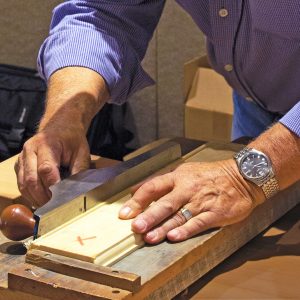
Then the afternoon was spent learning to saw, tuning up the shooting boards and learning to shoot end grain.
The sawing and shooting part of a class is one of my favorite things to teach. At the beginning of the exercise, the sawing sounds, stances and results are terrible. But within a couple hours of work, almost all of the students are able to saw square and vertical without any pencil lines to guide them. They are able to start a saw smoothly and advance quickly into the work. They are ready to cut some tenons and dovetails.
Which is a good thing because tomorrow is going to be a long day of dovetails.
— Christopher Schwarz
• Read yesterday’s entry from the class: Video: Build a Moxon Double-screw Vise
• Want to learn to saw? Pick up a DVD of “Build a Sawbench,” where we filmed a weekend class of me teaching a bunch of students how to saw and build a … wait for it… sawbench.