We may receive a commission when you use our affiliate links. However, this does not impact our recommendations.

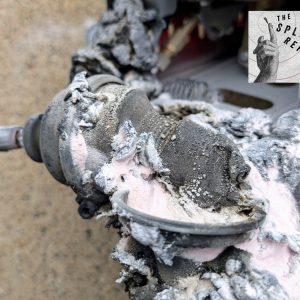
It’s pretty clear why this joint came apart. Most of the dowel and the mortise aren’t coated with glue.
Why does so much factory furniture, made with dowel joinery in the last forty or fifty years, often not hold up well? I have two explanations, both of which are shown in these pictures of chair arms.
The first is that the dowels aren’t coated well with glue. The way gluing on a production line so often works is that a little glue is dropped into the dowel hole as the part moves along the conveyor. Then, when the dowel is inserted, there’s not enough glue to squeeze up and coat the entire dowel. Only the tip of the dowel gets coated.

This dowel and mortise has even less glue on it.
So why don’t manufacturers simply insert more glue so the dowels do get coated? Because they are erring on the light side to be sure there’s no squeeze out that would block stain from penetrating the show surface around the joint. Squeeze out slows production a lot because of the time it takes to remove it and sand the wood smooth. Best to just to avoid it altogether.
The second explanation is the dowels themselves: fluted instead of spiral-grooved. The first principle of gluing is to achieve tight wood-to-wood contact. Said another way, you can’t glue air. So, though fluted dowels might make it easier for glue to squeeze farther up the dowels, there’s very little actual wood-to-wood contact. Most of the area is the recessed “flutes.”

From the left are a spiral-grooved dowel, which I think is the strongest, a fluted dowel, a home-made dowel grooved with the aid of my home-made jig at the top from a dowel rod at the right.
It’s been my experience that spiral-grooved dowels are far better because there’s so much more wood-to-wood contact. Why the spirals at all? Because they allow excess glue to squeeze out when the parts are clamped – that is, to not be trapped at the bottom of hole, which would prevent the dowel from penetrating deep enough.
Even with the spiral grooves, though, the best practice is to coat both the dowels and the sides of the holes with the glue using a brush. Pour some glue into a plastic or glass container, ideally with a lid to keep the glue from drying out, and work from it. Using a brush to coat the surfaces is very fast.

Using a brush to apply glue is much more efficient than a typical spout container.
– Bob Flexner
Brian Boggs shares his technique for strong dowel joints in his video, Accurate Dowel Joints, available on our streaming site for $3.99. It’s a fascinating peek into the world of chair making and green woodworking.