We may receive a commission when you use our affiliate links. However, this does not impact our recommendations.
 Note the wheel in the lower right corner – ouch.
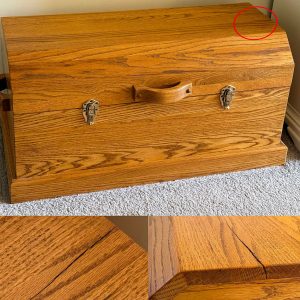
No, I didn’t drop a chisel on my foot or get bit by the table saw. But I did run into challenges of several sorts in the shop this weekend while working on a Shaker blanket chest with half-blind dovetails for an upcoming issue, and I had no recourse but to compensate for less-than-ideal conditions (which I suspect is something many of us have to do in the shop from time to time).
A few years back, Christopher Schwarz added wheels to my LVL Workbench (a bench he and I built for the Nov. 2009 issue). The wheels are a great modification – especially when the bench needs to be moved the 50 yards from the shop to the photo studio, because LVL is incredibly heavy stuff. The wheels can be flipped out of the way so that the bench drops back down onto its legs to bring it to my preferred working height, which is 29″ (note that the dimensions given in the article for the bench are sized to a woodworker of a more average height). But the bench was on its wheels – and, again, LVL is incredibly heavy stuff; I am physically incapable of lifting my bench enough to flip the wheels out of the way (heck – I can barely lift it at all), and I couldn’t ask someone to come in just to make my life easier.
So I was stuck sawing and chopping dovetails at about 5″ higher than is comfortable for me.
When sawing, I had to compensate both with the trajectory of my sawing arm and my wrist angle – which meant that I tired out more quickly because unaccustomed muscles were in play.

The red line indicates where my bench hits when it’s on its feet, rather than on the wheels.
Chopping took even more compensation, in terms of extra time – I couldn’t achieve my usual (admittedly wimpy) mallet swing because I had 5″ less room between the top and bottom of the action (yes, 5″ makes a heck of a difference – at least to me); I figure each half-pin socket took me at least a third longer than usual to clean out because I had to make a few extra cuts on each to reach the baseline. And paring to remove waste in the corners was more of a challenge, too, because I couldn’t get all the way over the work to use my full body weight behind the chisel. Very tiring.
And now, two days later, my shoulders hurt. A lot.
But both the sawing and the chopping challenges are easily solved – I simply have to ask Bob Lang and Glen Huey to help me out and get my bench back to working height.
The bigger challenge, though, is that my eyes (and the rest of me, I suppose) are fast approaching decrepitude; I can no longer focus close up, even with my reading glasses. Today, I went to the eye doctor, assuming the easy fix was a new prescription. And it is – but those glasses would be clear only for very close work (less than 10″)…such as dropping a chisel into a knife line on walnut. Then, I’d have to switch to my “regular” reading glasses for the bulk of the work, no doubt dropping my chisel out of the knife line as I fumble with the specs change. (And then switch to my distance glasses to walk from the shop to the office if I want to clearly see the path.) That seems silly; I need that ultra-close focus for about 1 percent of my week.
Instead, I’m going to invest in an additional bench light and play around with raking angles, in hopes that will make things a little easier to see from a little farther away. And, I’m going to score my layouts more deeply with the cutting gauge and marking knife, so I can more easily find things by feel. Both should help me compensate – at least for a few years, until I break down and buy trifocals. Or begin to work only in light-colored woods, on which layout lines are easier to see.
p.s. Note that bench height is up there with pins first vs. tails first for fomenting debate. The picture above shows what works for me (or really, what doesn’t work for me) – a 5’6″ predominantly hand-tool user who owns metal-bodied planes. There are no hard and fast rules; there are a lot of opinions. I have no dog in this fight. Or cat.
p.p.s. If you want to read more about the “perfect” bench how to make a bench that’s perfect for you, I recommend “The Workbench Design Book” (which also includes the LVL bench).