We may receive a commission when you use our affiliate links. However, this does not impact our recommendations.

Don Williams is like a shark in a clown suit. He’ll bite you in half while you are laughing.
During his presentation at Woodworking in America last weekend, I am quite sure that he destroyed the assumptions about pre-industrial woodworking of many of us in the room. And he did it with jokes, amazing slides and a smooth delivery.
His talk was far-ranging, and in the end it was like a Freakanomics lecture. He convinced me that 19th-century public health efforts are what ultimately led to the near-complete domination of machines in woodworking. But for me to explain that point would take more words than a blog entry should deliver. So let me just give you a taste.
One of the assumptions of many moderns is that powered woodworking machinery was an invention of the Industrial Revolution in the late 19th century. That before that point, there were no machines and that woodworkers would go off to their shops and “commune with the wood” while they slowly crafted their masterpieces with hand tools, Williams said.
The truth, he said, is much different.
The first powered saw, a reciprocating up-and-down saw powered by water, appears in Augsburg, German in 1337. He showed us a photo of a reconstructed version of the machine, which they called a water-powered sash saw.
Gang saws that slice an entire tree into slabs in one pass appear in the 1750s. Circular saws were not invented by the Shakers, Williams said. He has evidence that circular saws were in use circa 1575, probably in Holland and drived by windmills. And circular saws were widely in use by the 1750s. (He showed us a Spear and Jackson catalog from 1791 that was offering circular saws.)
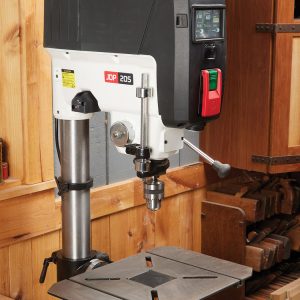
And Williams then took us on a tour of all the other major woodworking machines and their appearance in the historical record, including planers, jointers, drill presses, dovetailing machines, double-tenoners and on and on. All were pretty much up and running by the 18th century.
This small bit of his lecture was extremely helpful to me as a furniture maker. I’m making a reproduction of a Shaker side table from the White Water, Ohio, community and was completely vexed by the top of the table. I inspected the table completely for tool marks to try to suss out how the table was made. But some tool marks on the underside of the top led me to think that the top was a replacement. But the rest of the tool marks on the top suggested to me that the top was original and the joinery to attach it was done with a saw and rabbeting plane.
With Williams’s scholarship, I think it’s OK for me to reproduce the table as it is now. There’s a good possibility that the lumber could have been sawn and planed by machinery.
And that was worth the price of admission.
– Christopher Schwarz, photo by Narayan Nayar