We may receive a commission when you use our affiliate links. However, this does not impact our recommendations.

I continue to get a letter about every other day about the Roubo-style workbench I built for the Autumn 2005 issue. I’ve been trying not to clog up the weblog with too much Roubo stuff, but as the glue dries on the web frame in the Creole Table this morning, I thought I should bring up some interesting points from readers and discuss a few modifications I’ve made since I built the bench a year ago.
Robert W. Mustain pointed out to me that I neglected to discuss how to configure the workbench for left-handed woodworkers (which make up about 13 percent of the population, according to some estimates). A “Sinister Roubo” would need everything reversed, of course. Put the crochet and leg vise on the right side of the bench. Same goes for the planning stop: Put it on the right.
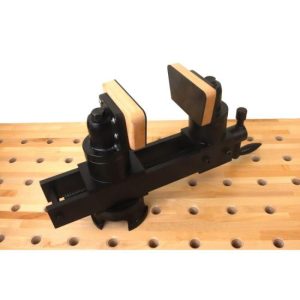
A common question among first-time bench builders is why the accessories are configured the way they are. Why is the bench vise (or crochet) traditionally on the left side of the bench for right-handers? They typically think that having the vise on the right side of the bench would make it more convenient for sawing off stock.
The reason the vise is traditionally on the left is for edge-jointing. You want to plane into the vise and sometimes even brace your boards against the vise’s screws or bars. It just makes sense from a physics point of view, really. Think about the alternative: If you clamp the tail end of the board and then plane away from the vise, you could pull the board out of the vise.

Next question: Reader Tim Brun asked if I’d added any more dog holes to my bench than those shown on the illustration in the magazine. The answer is yes. My biggest frustration with planing on the bench has been when I want to work cross grain, such as when I work rough stock with a fore plane. I’ve used holdfasts and battens to brace the work at the back edge of the bench; and while that works, sometimes I really just want to clamp stuff between dogs. So I added a line of 3/4″ holes (10 of ’em) in line with the planing stop (which is 6″ from the front edge of the bench). The holes are 3-3/4″ on center. The first hole begins 31″ in from the left end of the bench. Having them in line with the planing stop allows me to clamp a board 52″ long between the stop and a Veritas Wonder Dog.
Here are some other modifications: This morning I added leather linings to the faces of my leg vise on the advice from a reader. I was at Michael’s craft store last night picking up some hemp twine (for a future weblog post) and I noticed the overpriced leather scrap section. A one-pound bag of scraps cost $5.99. Or I could buy a single piece of Tandy-brand leather that would fit perfectly for $5.99. I bought the Tandy leather. I was going to cut up some shoes or an old purse that belonged to my spouse, but I hadn’t got the guts up to ask: “Honey, do you really use this purse anymore?” So $5.99 avoided that conversation.
The leather is an experiment. I think the leg vise holds just fine as it is. But the reader said I’d be amazed. So here goes. I used yellow glue to apply the leather, and I almost forgot to put a sheet of plastic between the leather pieces as I closed the vise. The glue-squeeze-out would likely have glued the whole thing together shut.
One final mod to the leg vise: I kept snapping the 3/8″-diameter oaken pivot pins at the foot of the vise. In hindsight, perhaps I should have used Ã?½”-diameter stock. I switched to a 3/8″ steel pin nine months ago and everything is working swimmingly.
The glue in the web frame should be dry now. Back to the shop.