We may receive a commission when you use our affiliate links. However, this does not impact our recommendations.

When in Canada, you do need to be careful about what you use your toothbrush for.
At woodworking schools in the United States, a lot of them use a wet toothbrush to remove wet glue squeeze-out from the inside corners of a carcase. But when teaching a tool chest class at Rosewood Studio in Perth, Ontario, I found the situation to be turned upside down.
Right before we began gluing up tool chests, I asked for an acid brush to apply the glue.
“Acid brushes,” says Ron Barter, the owner of Rosewood, with a little bit of an eyeroll. “How long are the bristles? Too long. They have to be trimmed. Where do the bristles go? Everywhere you don’t want them.”
Instead, Barter uses toothbrushes to apply the glue.
“They have to be the old-style square ones,” he says about the brushes. “It’s like a trowel for laying adhesive for a floor. A straight-bristle toothbrush does the same thing and leaves the right amount of glue.”
The other nice thing is that the toothbrushes don’t rust like the metal acid brushes. The rust can get all over the work.
So what does he do about squeeze-out? Barter waits just long enough until the stuff hardens a bit to look rubbery.
“Then I I take a friend’s plane iron – and that’s key – and lay it down flat on the board. And I carefully slice the projecting glue beads off.”
With carcases, Ron and his students finish the inside of the case before assembly and use wax to prevent the glue squeeze-out from ruining the inside.
To see the first student in this class assemble his chest, check out the video above. Hans just finished the 12-week Craftsman program at Rosewood and is staying on at the school for additional training.
— Christopher Schwarz
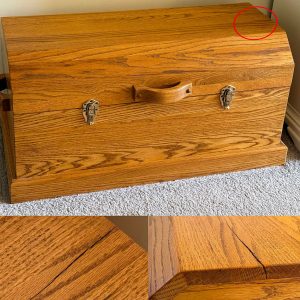
P.S. The chest we’re making is from “The Anarchist’s Tool Chest,” which discusses classic chest construction and the set of tools needed to build most forms of furniture.