We may receive a commission when you use our affiliate links. However, this does not impact our recommendations.

“It will be necessary that I teach them how to choose their tools that are made by Smiths, that they may use them more with ease and delight, and make both quicker and neater Work with them.”
Few people in the world of hand tools rouse people as much as John Economaki, the founder of Bridge City Tool Works. He has a passionate customer base that keeps its collective lip buttoned on the Internet, and a vocal chorus of critics that doesn’t.
Critics charge that his tools are too expensive, that some of his tool designs are too specialized to one segment of the craft and that his marketing copy tries too hard. So when you meet him, you expect Economaki to be rich, snobbish and overly proud of his product.
During the last 16 months, I’ve become acquainted with Economaki. And the more I talk to him, the less I understand the critics. He is, unlike many people who make tools in this world, one of us. He was a woodworker, an industrial arts teacher and a professional furniture maker before he started making tools.
He is, like many toolmakers, struggling to remain profitable, he’s quite earthy and he’s the biggest critic of his own designs.
“Ah, you see this,” he said today about one of the parts of one of his planes, “this is a design flaw. I should have put a magnet in there so it would stay in place as you tighten the lever cap.”
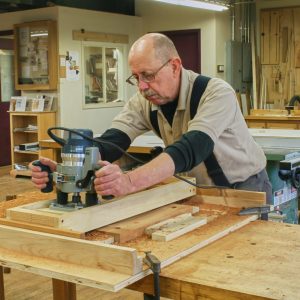
This week, Economaki is in our shop here in Cincinnati to show us some of his newest designs, share thoughts on CAD software and give a presentation to a group of our readers. Today, Economaki and our staff spent the day in the shop, working with his tools, chatting about woodworking and discussing the state of toolmaking in this country.
Time with Economaki makes my head hurt. It’s common to start on a conversation about try squares that shifts to tricks to determine accuracy using a cylinder of steel to biographies of Albert Einstein to the legacy of Sam Maloof. All that happened in about three stoplights while in my car on the way to his hotel.

But the most interesting thing about the day was getting to spend time with his tools. They are as much about design as they are about function (kind of like fine furniture, don’t you think?). He admits that freely and says his tools aren’t for everyone. As to the criticism that the tools are “too expensive,” you don’t feel that way after you use the tools and understand a bit how they are made (entirely in the United States).
I’ll admit, some of his tools don’t appeal to my eye or the way I work, such as the Japanese saws. But other tools of his have a remarkable pull.
When Bridge City started making the SS-2 Saddle Square, I ordered it as soon as I saw it and have never regretted it. The tool has been in every shop apron that I’ve worn to shreds while working at the magazine, and I carry it to every show.
The Saddle Square is functional, yes, but it also delights me. It pushes me to work better. And as its brass surface has become scratched, tarnished and worn over the years, my woodworking has become tighter, lighter and easier.
And that’s worth something.