We may receive a commission when you use our affiliate links. However, this does not impact our recommendations.
 When it comes to finish, I want something that is easy to apply, offers a little protection and doesn’t require spray equipment. And once I find a finish I like, I tend to be pretty loyal. I used Minwax’s Antique Oil Finish almost exclusively before a friend turned me on to Waterlox Original Sealer/Finish about a dozen years ago, and it’s been my go-to finish since. Both of these finishes are thinned varnishes that are easily applied with a rag. I’ve tweaked and refined my application methods a few times over the years, but because both are pretty much idiot-proof, the final result has always been satisfying.
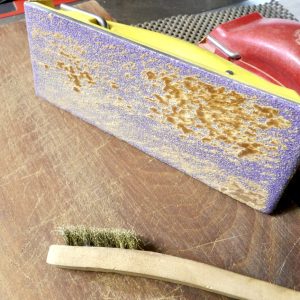
I generally flood on a coat, wet-sand later applications with automotive sandpaper and then wipe it almost dry. I just lay on coats and build it up until I get the sheen I want. I’ve applied as few as three coats and as many as 20.
A friend once asked me how to apply it. I gave him a few different methods, including brushing, to choose from, but in the end I came to a realization. “It doesn’t really matter,” I told him. “Just make sure it’s sanded between or during coats, and apply them until it looks right.” It’s a flexible finish that has never given me much trouble. Until lately, that is.
Shortly before Christmas I was nearing the end of desk that was due to a client. I’d applied about five or six coats to the desktop, but it still didn’t have quite enough shine. I reached for the can of Waterlox and found it empty. The desk would have been fine as it was, but instead I drove a half-hour to Woodcraft and bought a new can.
Josh, who works in my shop, has put on plenty of finish and was used to Waterlox, so I handed him the can told him to go ahead and lay on another coat. When I walked back into the shop about about 10 minutes later I was struck by two things: 1) The smell was so strong and uncommon that I ignored the winter temperatures and immediately started opening windows and 2) The desktop looked horrible. The finish was dry in some spots, wet in others.
“Something’s wrong,” said Josh. “I don’t think this rag is any good. Too textured or something?”
We scrambled for a moment, but finally I resolved to let it dry and then try to save it later. How could anyone mess up Waterlox?
 The next morning I started to lay on another coat using wet-dry paper as always. I’ve used the stuff for years and have developed some kind of muscle memory that guides my application – and I can tell from the resistance under my hand how much time I have before it starts to dry. But something was wrong. One side of the small desk was dry before I was done working on the other side. And the smell! I though I was going to pass out, suffer brain damage, or both.
I tried and tried. Nothing worked. This was clearly a different product. After a half-dozen attempts I got vaguely competent with its working qualities, but there was no time for wet-sanding during application as I’d always done before. It had to go on with a rag, and I had to sand between coats instead of wet-sanding at subsequent applications. The desk was delivered late, but I finally got the finish to look decent and the client was pleased.
When I bought a new can of Waterlox I compared the two. The one that had given me trouble had a subtle message in the sunburst on the can, “VOC Compliant,” I think it said. The new one, however, said, “Original Formula.” Eureka! I knew what to look for in the future, and I wouldn’t make the same mistake again.
A few days ago I was talking to Bob Flexner, our finishing guru, and he explained the problem. The new formula replaces the traditional solvent with one that is VOC exempt: paraclorobenzotrifluoride (PCBTF). The MSDS says they added 65 percent. Bob explained that it has dissolving qualities similar to mineral spirits, but it dries a little faster – this explained why one end of desktop dried before I could finish up my work on the other end. Bob also asked about the smell, which PCBTF is known for, but he confirmed that it isn’t toxic. Toxic or not, the smell certainly isn’t pleasant.
Luckily for me, the state where I live doesn’t have to sell the VOC-compliant version. Yet, at least. That Woodcraft was selling the VOC-compliant version was probably just a shipping error, I’m told. But I wonder, have you run into similar problems with VOC-compliant finishes, Waterlox or otherwise? If so, how has it affected your work?
To learn more about finishing from the guru himself, check out the sale on titles from Bob Flexner: Wood Finishing 101 and Flexner on Finishing. The always reliable Understanding Wood Finishing is also available.