We may receive a commission when you use our affiliate links. However, this does not impact our recommendations.

The back page of the upcoming issue of Woodworking Magazine (which mails to subscribers at the end of November) focuses on wood structure. What’s the difference among ring-porous woods, non-porous woods and diffuse-porous woods (not to mention semi-diffuse/semi-ring porous)? What’s a tracheid? A vessel? What’s meant by earlywood and latewood? And most important, what’s it all mean to a woodworker?
While researching the topic (I know far more about parenchyma cells and fusiform rays than my high-school biology teacher would ever credit), I discovered that cherry and maple are diffuse-porous woods, and therefore ought to take up stain fairly evenly according to the basic structural properties they share with all diffuse-porous species. But if you’ve ever worked with cherry and maple, you know that’s not the case. They can get blotchier than Chris in his Clearasil days.
So what’s the explanation? Our money is on elves. R. Bruce Hoadley doesn’t provide an answer in “Understanding Wood” (our wood technology bible). The Forest Products Laboratory doesn’t have an answer. Our finishing expert Bob Flexner doesn’t have an answer…¦and neither do any of the several world-renowned wood technologists he’s asked (though apparently, Bob has a scientist in Switzerland looking into it).
Anecdotal evidence points to stress. The explanation goes like this: In the winter, when snow is piled up on tree limbs, they’re bent down under heavy pressure. Or in windy forests, gusts stress limbs in a constant direction. These areas of stress change the grain pattern, and the irregular grain pattern is where the blotching occurs. Uh huh. This apparently has yet to be scientifically proven. Black walnut (another diffuse-porous wood) doesn’t blotch…¦or when it does, it’s good-looking blotch. Black walnut’s natural range includes western Vermont. I’m pretty sure it snows there.
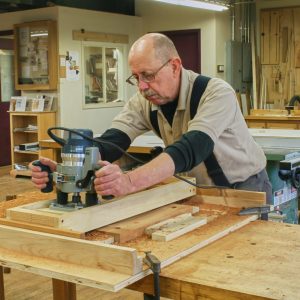
I still think it’s elves (the fellow pictured above is named Eugene)…¦but I’m willing to entertain other explanations, should you care to comment below.