We may receive a commission when you use our affiliate links. However, this does not impact our recommendations.

Can we not agree that I am not of sound mind and body? Yup? OK, read on.
Last year I commissioned blacksmith Peter Ross to make a holdfast for me that was made as close as possible to Andre Roubo’s instructions. Ross is quite familiar with Roubo, but I sent him a translation of the section on holdfasts that a friend did a few years back that also converted the French inches to modern inches.
French inches are longer than modern inches. Click here to read more on that subject.
After some draft drawings, Ross began work on the monster. It was so large he had to hunt especially hard for a piece of iron that was 2-1/2” diameter. Last week, Ross told me the holdfast was complete. He’s going to hand it over while I’m teaching my class on building a tool chest at Roy Underhill’s The Woodwright’s School.
How does the holdfast work? We don’t know.
“I can’t try the thing out – it’s too big,” Ross wrote in an e-mail. “This project was a handful, but came out looking good.”
I couldn’t agree more. I have a lot of ideas about this large-scale holdfast that I’ll share here on the blog when I return from North Carolina. In the meantime, enjoy the following translation of Roubo’s text on holdfasts and the photos from Ross.
— Christopher Schwarz


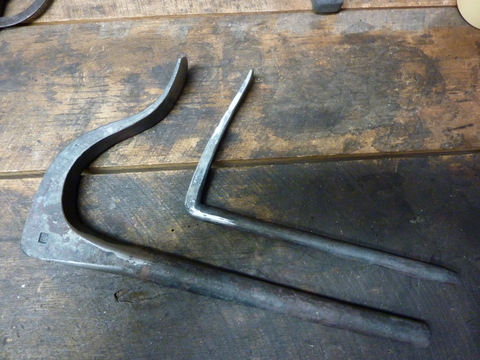


Holdfasts are tools made of iron and are used to hold the work on the bench firmly and stably. They are ordinarily 18” to 20” and even 24” long in the shank; their thickness must be between 12 to 15 (1-1/16” to 1-5/16”) lines, and the curve of their paws is 9” to 10” long by around 10” high. They must be of very soft iron, forged in one piece so they don’t break. All their strength is in their head. That is why we will observe that from the head g to the paw k, they get thinner so that their extremity only has two lines (3/16”) of thickness at the most, which will make them more flexible and increase their pressure.
We must curve them so that when they are tightened they will only grip by the tip of the paw, because if they would carry more pressure in the middle they would ruin the work and hold less firmly.
Moreover, it is easy to see that after long use, the shank of the holdfast will widen the holes of the workbench; and if it didn’t grip well by the tip, before long, it would soon carry all the pressure on the back of the paw and cause the problem I have mentioned above.
Engage the holdfast by hitting it on the head g with a mallet and release the holdfast by hitting the head in the other way, that is on its side and upward or on the side of the shank.
Holdfasts must never be polished because then they will not hold well. They should only be roughed up with a file or stone. Only the paw must be clean and polished so it does not mar the work.
The “leg holdfasts” are not different, other than they are smaller. They hold the wood on its edge along the length of the workbench with the help of the wooden hook m, figure 1. This hook is fastened with screws or strong nails on the front edge of the workbench’s top and is sometimes arrayed with iron points. But because the points often ruin the work, it is best to remove them or to make them like in figure 5 (see the illustration of the hook).