We may receive a commission when you use our affiliate links. However, this does not impact our recommendations.

Here’s a basic trick for planing up the rails and stiles for your doors.
If you use power sanders, move along quietly to some other blog entry. The random-orbit sander was pretty much invented to solve this problem that occurs in traditional work.
So you’ve cut the joinery on your rails and stiles and are getting ready to assemble the frame, be it a door or face frame.
Planing the rails, which have the tenons, is usually no problem. But the stiles can be a bear to plane down, especially when planing the face of the work near or on top of the mortise. The mortise wall bends a little, denying the cutter the ability to plane the work. And if you plane the stiles a bunch of times without managing to plane the material over the mortises, your stile will become bowed.
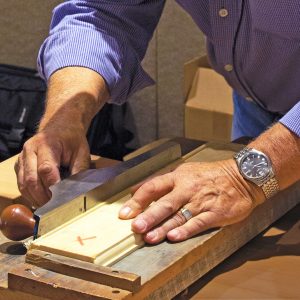
So I loosely assemble the frame when I plane up the parts on the bench. This does two things to make my life easier.
1. The tenons support the mortise walls, allowing you to plane the stiles easily. You don’t need to fully seat the tenon in the mortise – just get about 1/4” in there and everything will work.
2. You can check the fit of the rails and stiles with ease. After planing the stiles, I knock the rails into their joints and see if the faces are aligned. If they aren’t aligned, I knock the two bits apart and remove the high spots with a plane.
I know I’ll get some questions about the photo above. Yes, I plane both left-handed and right-handed. It’s an easy skill to learn and gives you a head start on working with hollows and rounds, which require left-hand work at times.
In fact, learning to do many operations – especially chisel work – is a fantastic skill to learn and makes workholding at the bench a lot easier.
— Christopher Schwarz