We may receive a commission when you use our affiliate links. However, this does not impact our recommendations.

Today we glued up two chunks of what will become Managing Editor Megan Fitzpatrick’s workbench.
For those of you just tuning in, I haven’t broken my vow of workbench chastity. The bench design isn’t new (it’s actually quite old), but the material we’re using is. The whole thing is going to be made out of LVL , laminated veneer lumber. So this is a story about a new material. Really. And it’s Megan’s bench, not mine.
After slicing into the LVL on the table saw I learned some of the finer points of this engineered material. Because of the laminations, there really aren’t any stresses in the planks. It cuts easily, like nice plywood.
I ripped each LVL 2 x 12 into four 2-3/4″-wide strips. Then I jointed the solid-wood faces of each strip. The nice thing about LVL is that the faces are thick enough to withstand a couple passes on the jointer before you cut through the lams , it’s like thick, old-school veneer.
The bad thing about LVL is the seams. Every six feet or so there is a scarf joint where the lams overlap one another. These seams determine the direction you should run the material over the jointer. I jointed one of them in the wrong direction and was rewarded with a big splintery bite at the seam. I’ll never do that again.
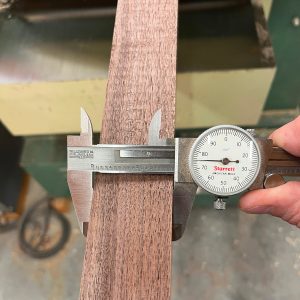
The material is fairly consistent. The first plank I sliced up was dimensionally perfect in thickness and width. The second one was not. One end was a little thicker than the other (about 1/16″) and the plank had a pronounced crook , but only on one edge. Crazy.
The only other bad thing I have to say about LVL is that because it’s (usually) made from Southern yellow pine, it’s pretty dang splintery. I’m in Detroit tonight for a photo shoot tomorrow and let’s just say I brought some LVL with me for the ride.
We glued up the two slabs with regular Titebond and left them in the clamps overnight. Yellow pine can have a lot of resin, which resists waterborne glues. So Titebond’s resident pointy head (Dale Zimmerman) recommends we leave it clamped for at least five hours. We’ll glue up the remainder of the top on Friday.
How will we flatten it? I’m still working on that. Megan keeps bringing up the fact that Senior Editor Glen D. Huey has a wide-belt sander that can handle a 24″ top.
– Christopher Schwarz