We may receive a commission when you use our affiliate links. However, this does not impact our recommendations.

Thanks to the long-term relationships I’ve made with lumber merchants, I have little trouble with them sending me crappy stock. But even after 20-something years of buying wood from my suppliers, there are times when I get a bogus load of wood.
Most problems can be solved by knowing what is standard in the industry. About 15 years ago, I bought 200 board feet of cherry from my dealer that was advertised as 4/4 rough and came into my shop at 13/16” thick in the rough.
I put my foot down and sent it back about five minutes later. After a tense standoff the dealer backed down and sent me true 4/4 stock, which should be more than 1” thick. Since that day, they have always sent material that meets industry specs.
But sometimes I get a load that has a fair number of case-hardened boards. I actually don’t blame the dealer (directly) for this defect – the kiln is in charge of this aspect of quality control. Recently I bought a lot of hard maple, and about 20 percent of the boards were case-hardened. That’s nuts. How do you prove it to the dealer?
At this point, I can take the junk boards back and ask for a credit. But if your dealer balks, Jeff Burks offers this excellent and simple test set forth by the U.S. Forest Products Laboratory.

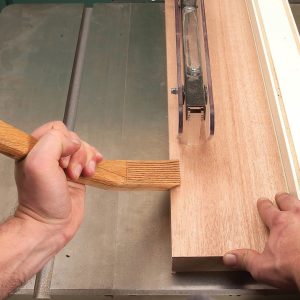
Starting about 2’ from the end of a board, crosscut 1”-long sections of the board in question. Then kerf the samples like you are making a fork and observe what happens.
Specific instructions are found in this bulletin:
Excerpt from – Technical_Notes_on_Wood_Properties_and_U333
Tonight I grabbed two of the maple boards from that load. One of them has been giving me fits. I performed the official test and the “tines” of the fork slammed shut immediately, indicating the board was case-hardened or had some unacceptable internal stresses. With the other board (a mild example) the tines remained parallel.
I threw the samples into my truck (along with the offending board) so I could have a future friendly discussion with the timber merchant. I know they’ll say it’s not their doing, but I also know they’ll make a phone call to the kiln or mill where they got the maple.
You might think I’m a jerk for doing this, and that’s OK. I just don’t want to pay $5 a board foot for firewood.
— Christopher Schwarz